
The sustainability of an offset ink does not end when the printed product leaves the press. Every year, large quantities of printed paper and board reach recycling plants, and the quality of the recovered material depends, among other factors, on how the ink behaves during this process.
If the ink does not separate properly from the fibres during repulping, it can make it more difficult to obtain clean, high-quality pulp. The ability of a printed product to release ink during recycling is known as deinkability, a property that is largely invisible to the end consumer but plays an important role in supporting the circular economy of paper and board.
What is deinkability?
Deinkability is the ease with which ink can be separated from paper fibres during the recycling process, known in the industry as deinking.
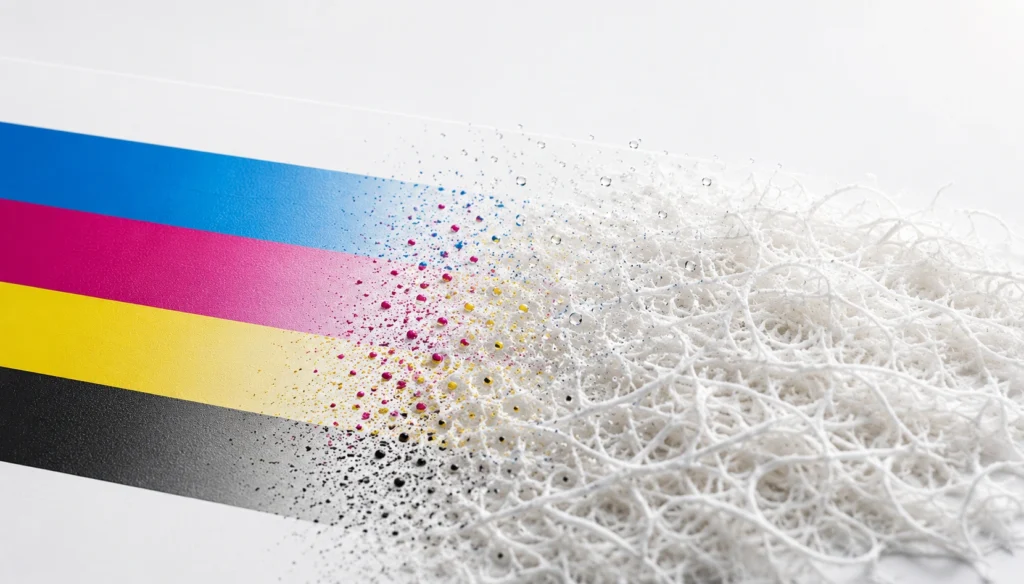
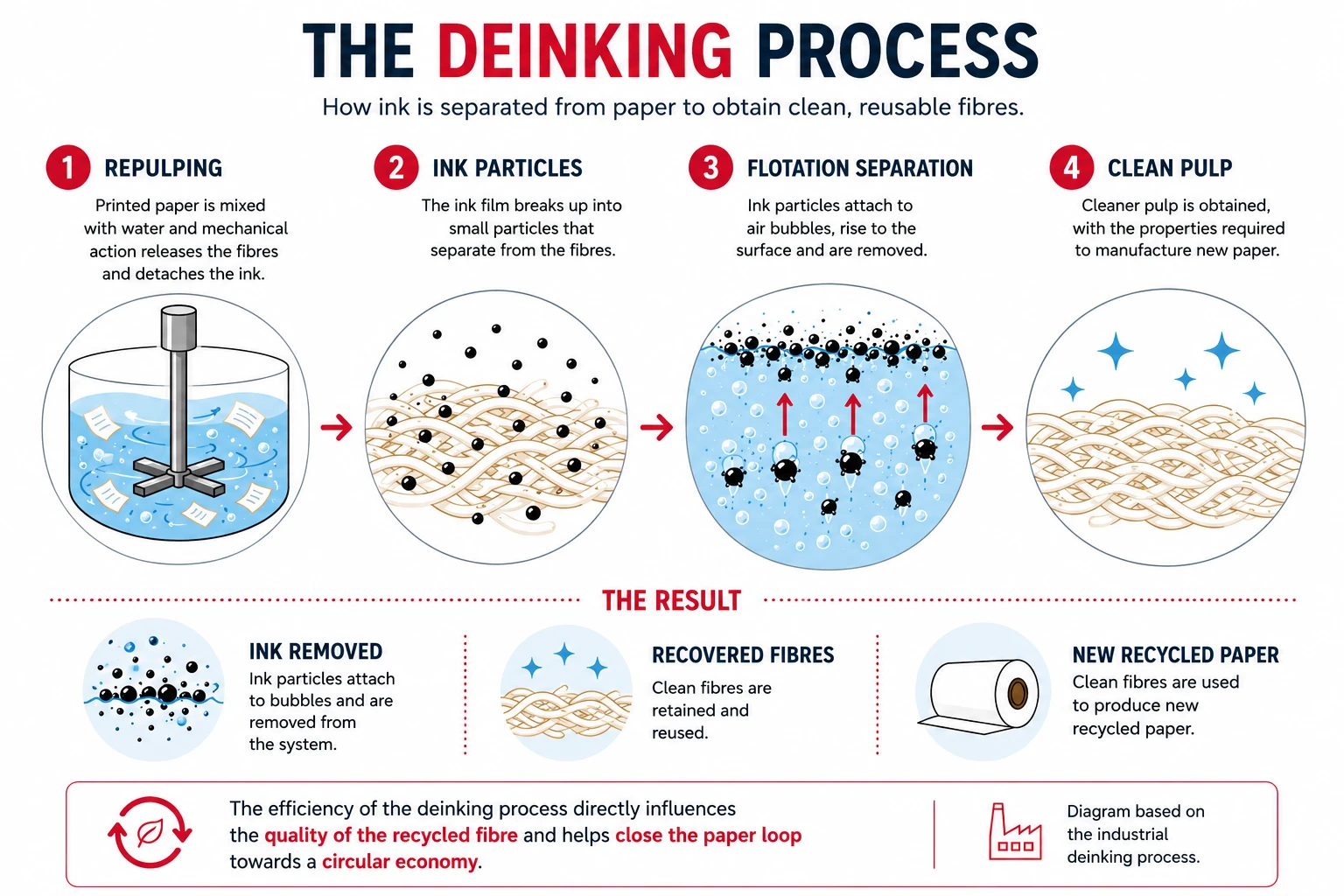
When printed material reaches a recycling plant, it is mixed with water and subjected to a repulping process that breaks down the paper and releases its fibres. During this stage, the ink must detach from the fibres and form particles that can subsequently be removed, mainly through flotation.
During flotation, air is introduced into the fibre suspension. Ink particles attach to the air bubbles, rise to the surface and can then be removed as foam. The aim is to obtain pulp with the cleanliness and optical properties required to manufacture new paper.
When deinking does not work properly, part of the ink remains in the pulp, reducing its brightness or leaving visible particles. This makes it more difficult to produce high-quality recycled papers and may limit the subsequent applications of the recovered material.
Recyclable and deinkable do not mean exactly the same thing
A paper or board product is recyclable when its fibres can be recovered and used to manufacture new products. Deinkability refers to a more specific aspect: the ability to remove the ink effectively during that process.
A printed product may therefore be made from a recyclable substrate and still show room for improvement during deinking. Effective recyclability does not depend solely on the paper, but on the entire system formed by the substrate, ink, varnishes, adhesives and other elements that may be present.
This distinction is particularly relevant in printed products and certain paper or board packaging applications where the aim is to keep fibres within recycling cycles that require high-quality pulp.
How deinkability is evaluated: INGEDE Method 11
One of the most widely used reference methods in Europe for evaluating deinkability is INGEDE Method 11, developed by the International Association of the Deinking Industry.
The procedure reproduces the essential stages of an industrial deinking process on a laboratory scale. Its purpose is not to analyse a liquid ink in isolation, but to assess the behaviour of a printed product, in other words, the specific combination of ink, substrate and printing conditions.
The results are interpreted through a score that evaluates aspects such as the optical and visual cleanliness of the pulp obtained after the process, as well as the amount of ink removed. The higher the score, the better the deinking behaviour of the printed sample analysed.
What does a high score mean?
The evaluation system converts the test results into a maximum score of 100 points. The higher the score, the better the printed sample has performed across the different aspects analysed.
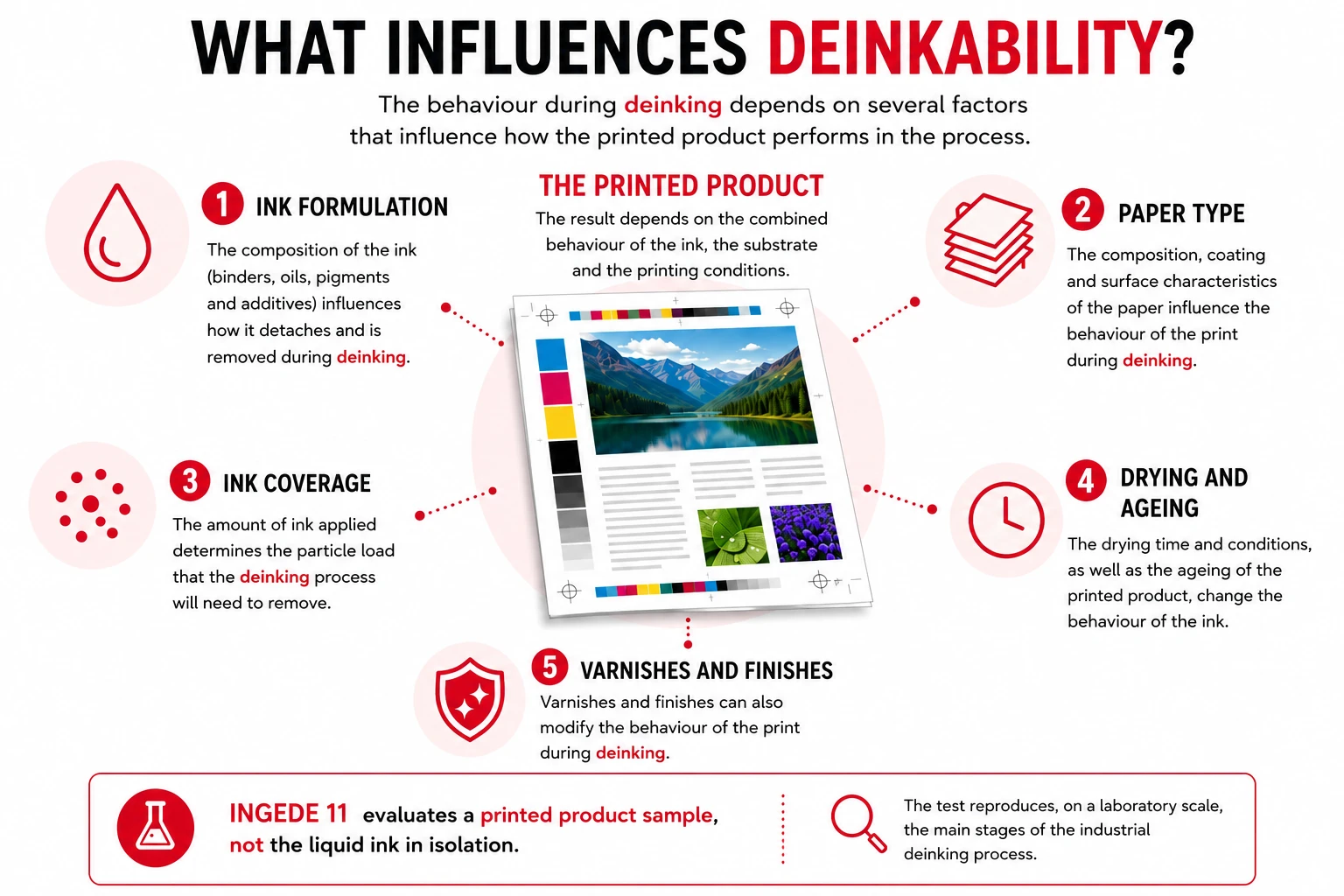
However, the result must always be interpreted in relation to the sample evaluated. Performance may be influenced by the ink, but also by the type of paper, ink coverage, drying system, applied finishes and production conditions. It is therefore more accurate to refer to the deinkability of the printed product evaluated than to attribute the result exclusively to one of its components.
The role of ink in the paper and board cycle
Recyclability is often associated mainly with the substrate: if a package is made of paper or board, it is usually assumed that it can easily be returned to the recycling cycle.
However, as we explained when analysing the replacement of plastic with paper in sustainable packaging, choosing a recyclable substrate is only part of the process. Inks, adhesives, functional barriers and finishing varnishes can also influence how the product behaves during recycling.
In the case of offset inks, factors such as the type of resin, oils used, pigments, additives and drying mechanism affect the way the ink film breaks up and separates from the substrate during repulping and flotation.
This does not mean that formulation is the only determining factor. Deinkability is the result of the complete system: the same ink may behave differently depending on the substrate, coverage, ageing of the printed product or subsequent finishes. For this reason, evaluation using printed samples provides more representative information than analysing the ink in isolation.
Why this criterion is becoming increasingly important
Deinkability is no longer a matter of interest only to recycling plants. More and more brands, printers and converters are looking for data that allows them to assess the effective recyclability of their products, rather than considering only the origin or nature of the substrate.
This development is particularly relevant in sectors such as pharmaceutical and cosmetic packaging or food packaging, where safety, performance and sustainability requirements must be considered together. In these applications, in addition to specific issues such as the German Ink Ordinance for packaging inks, brands are paying increasing attention to the end of the packaging life cycle.
For printers, having a score obtained through a recognised method provides objective data that can support material selection and help respond to customer requirements.
As with other aspects of sustainable packaging inks, sustainability does not depend on a single claim, but on technical decisions that affect the printed product as a whole.
Deinkability and the circular economy
The circular economy aims to keep materials in use for as long as possible and preserve their value through successive production cycles.
In the case of paper, it is not enough for the fibres to be recoverable. The quality of the resulting pulp also matters, because it determines which new products can be manufactured from it. Clean pulp can be used for more demanding applications, while darker pulp or pulp containing visible particles has more limited uses.
Deinkability therefore contributes to preserving the value of recovered fibres. By facilitating ink removal, it helps keep paper within higher-quality recycling cycles and reduces the need to rely exclusively on virgin fibre for certain applications.
BIO CF: a score of 99 out of 100
One example of this approach is BIO CF, a range of semi-fresh offset inks from MA Inks, formulated with vegetable oils and free from MOSH, MOAH and cobalt salts.
BIO CF achieved a score of 99/100 in an evaluation carried out in accordance with INGEDE Method 11. This result reflects the excellent deinking performance of the printed sample evaluated.
The range is designed to deliver high on-press performance, with high gloss, good rub resistance, fast drying and good ink-water balance. These properties make it possible to meet the production demands of offset printing while also considering what happens to the printed product once it reaches the end of its useful life.
BIO CF also complies with EN 71-3:2019, relating to the migration of certain elements in toys, and can be used in compostable packaging in accordance with UNE-EN 13432:2001.
You can find the full specifications of the range in the BIO CF technical data sheet in our offset inks catalogue.
Frequently asked questions about deinkability in offset inks
What does it mean for an ink to be deinkable?
It means that, once printed, the ink can be effectively detached from the paper fibres during recycling and removed during the deinking stages.
Does deinkability depend only on the ink?
No. Ink formulation has an influence, but the result depends on the complete printed product: the substrate, coverage, printing conditions, drying system and any varnishes or finishes can also affect its behaviour.
How is deinkability evaluated?
One of the main reference methods in Europe is INGEDE Method 11. The test reproduces the repulping and flotation of a printed sample on a laboratory scale and evaluates the optical cleanliness of the resulting pulp and the amount of ink removed during the process.
Does a high score guarantee that any printed product will be deinkable?
Not necessarily. The score applies to the specific sample and conditions evaluated. A change in paper, coverage, finish or process can influence the final result.
Why does deinkability matter if the paper is already recyclable?
Because fibre recovery and the quality of the resulting pulp are two different issues. Good deinkability helps produce cleaner recycled papers and broadens the range of possible applications for the recovered material.
Ink also helps close the loop
For years, the sustainability of printed products was associated almost exclusively with the type of paper used. Recycling, however, shows that all components can influence the ability to recover fibres and preserve their quality.
A formulation that supports deinking contributes to cleaner pulp and helps keep paper within higher-value recycling cycles. Ink therefore not only determines the appearance and performance of a printed product: it can also influence what happens when that product has fulfilled its purpose and becomes a raw material again.
If you would like to assess which MA Inks solutions are best suited to your printing, performance and sustainability requirements, contact our technical team.