
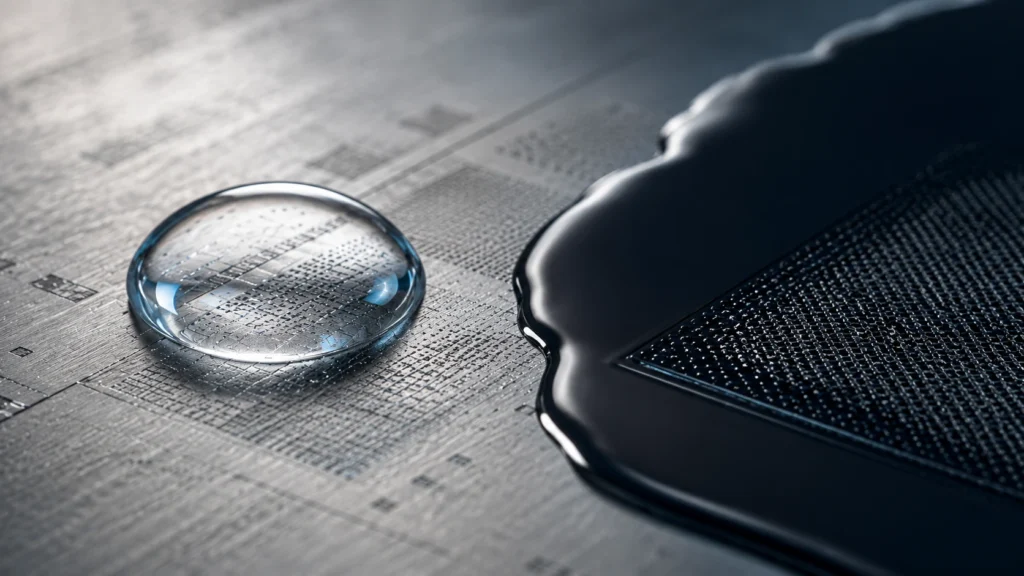
There is a paradox at the very heart of offset printing: two substances that repel each other —water and oil-based ink— have to coexist, in exactly the right proportion, on the same plate throughout the entire print run. Almost everything else depends on keeping that coexistence stable: color intensity, detail sharpness, drying, print cleanliness and, ultimately, how many acceptable sheets come off the press. This point of coexistence has a name every printer knows and respects: the ink-water balance.
In this article, we explain exactly what this balance is, why it is one of the factors that most affects print-run stability, what happens when it breaks down and how to keep it under control in the day-to-day operation of the pressroom.
What is ink-water balance and why is it at the heart of offset printing?
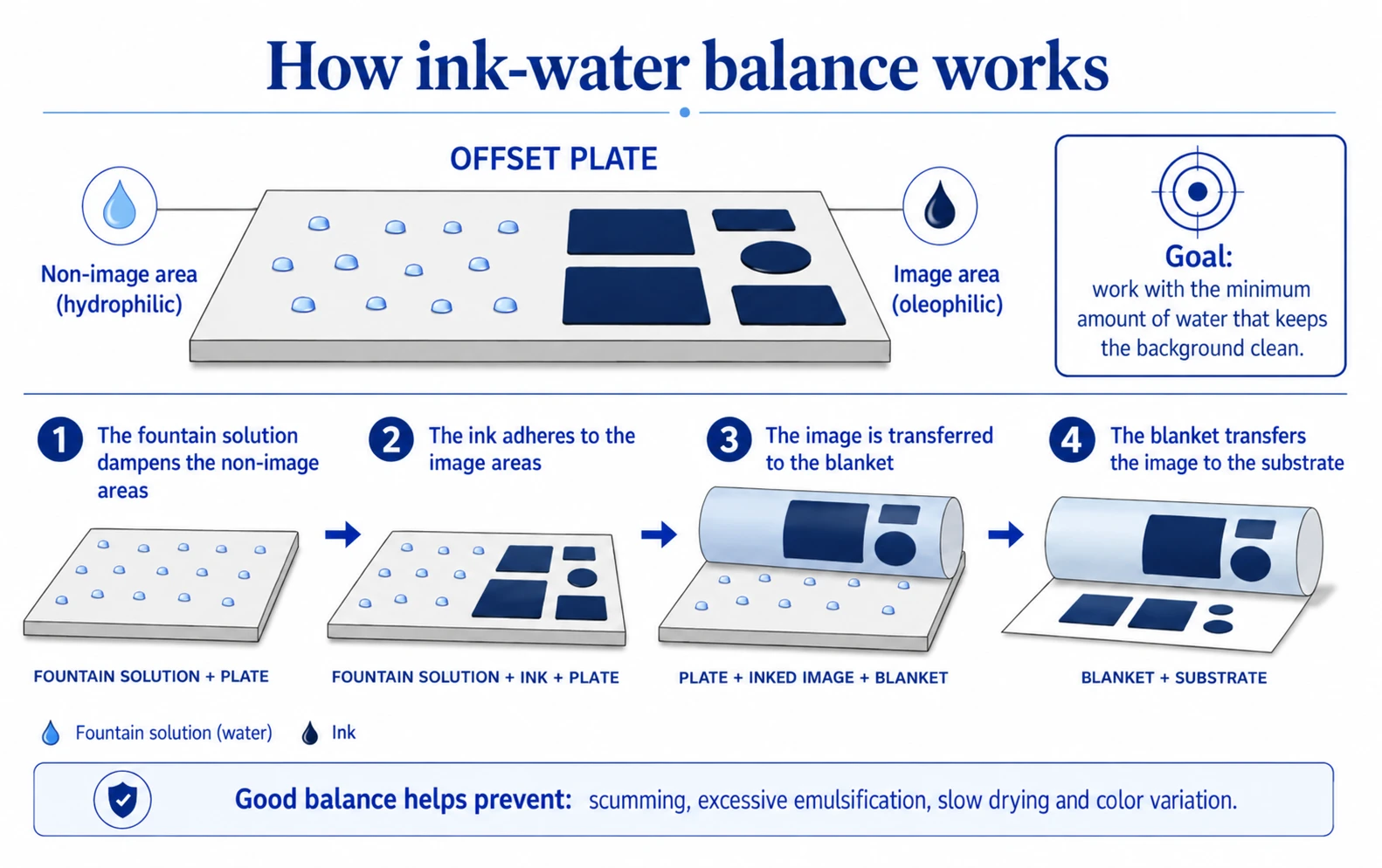
Offset printing evolved from lithography and is based on an elegant physicochemical principle: the repulsion between water and grease. The plate contains two types of areas on the same plane. The image areas are oleophilic: they accept the oil-based ink. The non-image areas —the background— are hydrophilic: they accept water and, when dampened, repel the ink.
The process involves two successive transfers. First, the fountain solution wets the hydrophilic areas of the plate; then, the rollers apply the ink, which adheres only to the image areas because the water on the remaining areas repels it. The inked image does not come into direct contact with the paper: it is first transferred to a cylinder covered with a rubber blanket, and the blanket then transfers it to the substrate. Hence the name offset: the printing process is indirect.
What turns all this into an art is the fact that water and ink do not remain completely separate. In practice, the ink incorporates a small amount of water in the form of a controlled emulsion. When this emulsion remains within the proper range, it does not alter the ink’s behavior: it maintains its tack, viscosity and transfer properties. Ink-water balance means precisely that: keeping this emulsion at the right level throughout the entire print run.
The balance window
There is a window —an operating range— in which the ink-water balance remains stable: the background stays clean, the image does not wash out and the print run maintains clean, consistent transfer. The wider this window is, the easier it is for the press operator to cope with the inevitable variations in the pressroom: changes in temperature, humidity, speed or substrate.
It might therefore seem that the wider the window, the better. But that is not always the case, and this is one of the keys that distinguishes the behavior of a high-quality ink.
An excessively wide window often means that the ink takes up a large amount of water. This can make it appear easier to run on press —because it tolerates excess water better— but the absorbed water may cause problems later: loss of color strength, reduced gloss, poorer rub resistance and difficulties in post-print handling. The print may look correct on press and still fail at a later stage.
That is why offset printing is not about allowing the ink to take up more water, but about working with the minimum amount possible: just enough to keep the background clean without compromising the ink’s properties.
The ink itself also influences this window. At MA Inks, a high-quality ink is characterized by low water uptake and stable lithographic behavior. This requires the process to be properly adjusted and the amount of water supplied to be reduced as much as possible —a common tendency on press is to use more water than necessary, and that is precisely the habit that should be corrected— but once the balance is achieved, the difference in quality is significant: greater color strength, higher gloss, better drying and improved rub resistance.
MA Inks conventional offset inks are formulated to provide excellent ink-water balance and to work with different dampening systems. To achieve this balance and obtain maximum performance, the water supply should be reduced as much as possible and the press should operate at the minimum level required to keep the background clean.
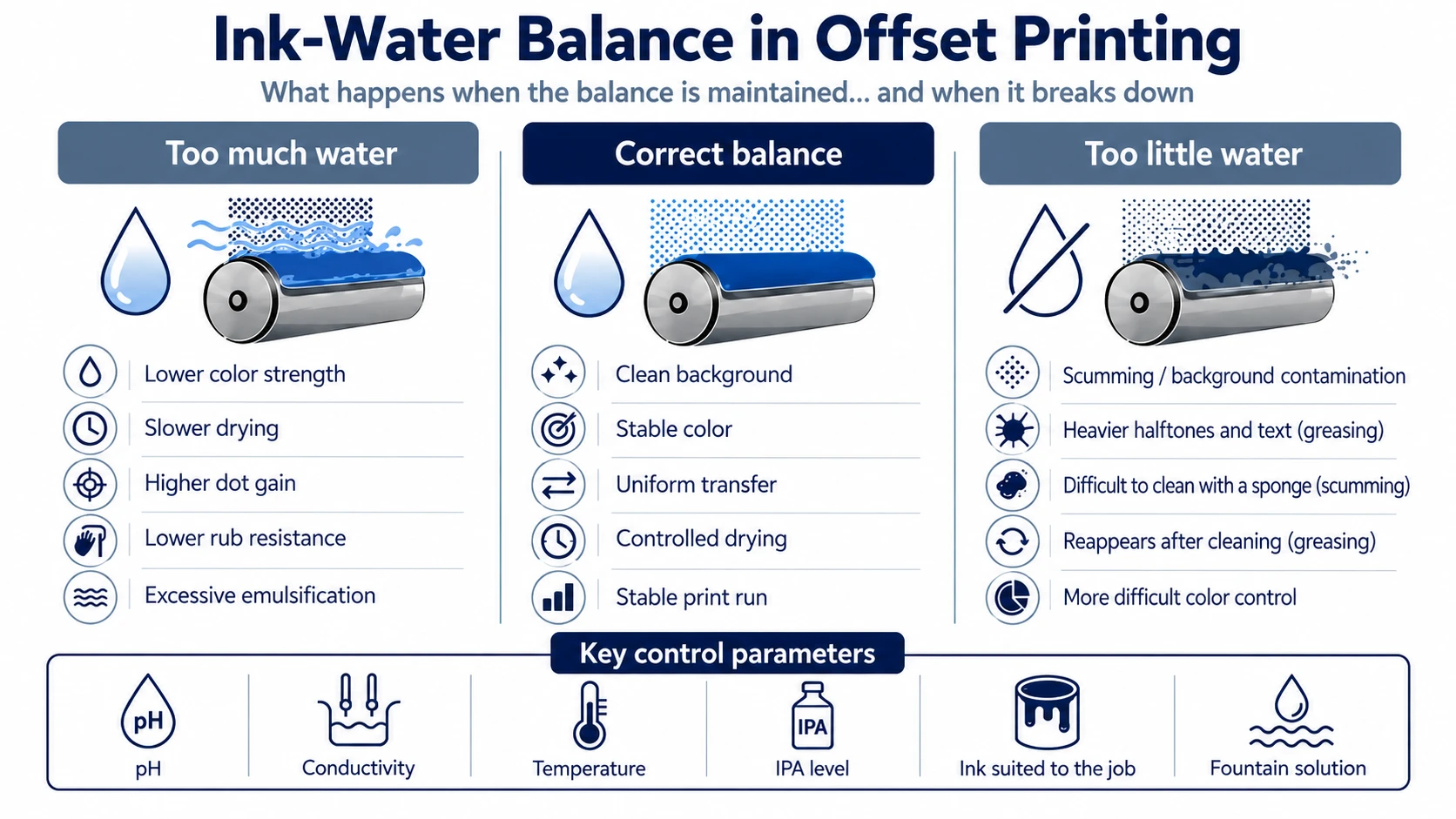
What happens when the balance breaks down?
Ink-water balance can break down in two opposite directions, and each leaves its own signature on the printed sheet.
Too much water
When more water enters the system than necessary, the ink absorbs too much of it and the emulsion becomes uncontrolled. The symptoms are easy to recognize: color strength decreases, drying is delayed, dot gain increases, rub resistance falls and instability develops throughout the print run. In severe cases, excessive emulsification compromises clean ink transfer.
Too little water
The opposite problem also has consequences, although not always through the same mechanism. When the water does not adequately protect the hydrophilic areas of the plate —because of incorrect pH, insufficient fountain solution dosage, excessive IPA or plate wear— scumming appears: a thin, continuous film of ink forms in the non-image areas and is difficult to remove even with a damp sponge because the plate has physically begun to accept ink.
Greasing is different: here the problem is not the plate itself, but the chemical balance between ink and water. When the water loses its cleaning ability —often because of insufficient fountain solution or conductivity outside the correct range— the ink spreads into the clean areas from the edges of halftones and text, making them heavier. Unlike scumming, greasing can be removed with a damp sponge… but it reappears after only a few revolutions.
Both problems contaminate the print and make color control more difficult, but they point to different causes: scumming indicates a problem with the plate, pH or dosage; greasing points to the ink and the emulsifying capacity of the fountain solution.
The challenge, therefore, is not to use “little” or “a lot” of water, but to find and maintain the minimum water level that keeps the background clean without destabilizing the emulsion.
Signs of poor ink-water balance on press
Beyond the underlying mechanism, it is important to recognize the problem from what can be seen on the printed sheet. These are the signs that indicate an incorrect ink-water balance on press:
- Loss of color strength or density. Even when enough ink is being supplied, excess emulsified water weakens the ink’s behavior and the color appears lighter than expected; increasing the ink supply to compensate usually makes the problem worse.
- Scumming or background contamination. Areas that should remain clean begin to accept ink, usually because of incorrect pH, insufficient fountain solution dosage, excessive IPA or plate wear that leaves the hydrophilic areas unprotected.
- Slower drying and risk of set-off. Excess water delays drying and setting, extending handling times and potentially causing set-off between sheets.
- Increased dot gain. The dot spreads on the paper and the image becomes darker and less defined; unstable ink-water balance is one of the common causes, alongside pressure and substrate characteristics.
- Color variation throughout the print run. If the balance shifts during production, the color of the first sheets will not match that of the last ones, forcing the operator to stop and make corrections.
- Halftones closing up or becoming dirty (greasing). Highlights and fine details lose definition because ink spreads into the edges of the halftone dots; this indicates a chemical imbalance between ink and water, caused by poor emulsifying capacity of the fountain solution or conductivity outside the correct range.
When several of these signs appear at the same time, ink-water balance should be the first factor checked before adjusting any other parameter.
How to keep the balance stable
Controlling ink-water balance is mainly about controlling the process. These are the main factors:
- Work with the minimum amount of water possible. This is the golden rule: use the smallest amount of water that keeps the background clean. Every unnecessary drop brings the system closer to imbalance.
- Monitor the pH and conductivity of the fountain solution. These parameters determine whether the water behaves consistently on the plate; deviations are responsible for many background contamination and emulsification problems.
- Stabilize the temperature of both the fountain solution and the inking units so that conditions do not drift during the print run.
- Adjust the IPA level —or eliminate it altogether— according to the system. The industry trend is toward reducing or eliminating isopropyl alcohol for environmental, safety and emissions-control reasons, provided the system is correctly adjusted.
This is where the fountain solution demonstrates its importance: it is not merely an auxiliary product, but a structural part of the printing system, just as important as the ink itself. A good fountain solution conditions the water so that it performs consistently, stabilizes the pH and makes it possible to operate with the minimum amount of water —and IPA— even at high press speeds.
And what about additives? They should be understood in their proper context. An additive is not part of the normal operation of the process: it is introduced only when a specific factor has deviated and the situation justifies its use. A well-formulated ink and a properly adjusted process do not require routine additives. Therefore, when an ink-water balance problem occurs, the first step is not to “add something”, but to check the water, pH, conductivity and whether the ink is suitable for the job. Additives are the exception, not the rule.
Frequently asked questions about ink-water balance
What is ink-water balance in offset printing?
It is the correct proportion between the water in the fountain solution and the oil-based ink during printing. The ink incorporates a small amount of water in the form of a controlled emulsion; keeping that emulsion at the right level throughout the print run is what is known as ink-water balance.
Why does offset ink emulsify?
Because the process brings oil-based ink into contact with the water-based fountain solution. A slight, controlled emulsion is normal and necessary; the problem begins when excess water causes excessive emulsification, affecting color strength, drying and stability.
What happens if there is too much water during printing?
Excess water reduces color strength, delays drying, increases dot gain, reduces rub resistance and can cause emulsification and instability throughout the print run.
What is scumming in offset printing and how can it be prevented?
Scumming is the appearance of a thin, continuous film of ink in the non-image areas, caused by a failure of the plate’s hydrophilic protection: incorrect pH, insufficient fountain solution dosage, mechanical plate wear or excessive IPA. Unlike greasing, it is not easily removed with a damp sponge. It can be prevented by keeping the pH and fountain solution dosage within the correct range and monitoring plate wear.
What is the difference between scumming and greasing in offset printing?
Although both contaminate the non-image areas, they have different causes. Scumming is a plate-related problem: the hydrophilic layer weakens and begins to accept ink directly, creating a continuous stain that is difficult to remove with water. Greasing is a chemical imbalance between ink and water: the ink spreads into the edges of halftones and text, but it can be cleaned off easily, although it quickly reappears. Distinguishing between the two is essential because each requires a different adjustment: the plate and pH in the case of scumming; the ink and fountain solution in the case of greasing.
How do pH and conductivity affect the balance?
These parameters ensure that the fountain solution performs consistently. A pH outside the correct range compromises the hydrophilic protection of the plate and promotes scumming; conductivity outside the correct range alters the emulsifying capacity of the fountain solution and can promote greasing. In both cases, the result is a less clean print and more unstable color.
Conclusion
Maintaining ink-water balance is not about correcting problems through constant adjustments, but about building a stable system from the outset: the right ink, a compatible fountain solution, controlled parameters and consistent press conditions. When these elements work together, the print run gains in cleanliness, color, drying performance and consistency.
At MA Inks, we develop inks and fountain solutions designed to make this balance easier to achieve under real production conditions. If you need to improve the stability of your print runs, our technical team can help you analyze the process and choose the most suitable combination. Contact us.