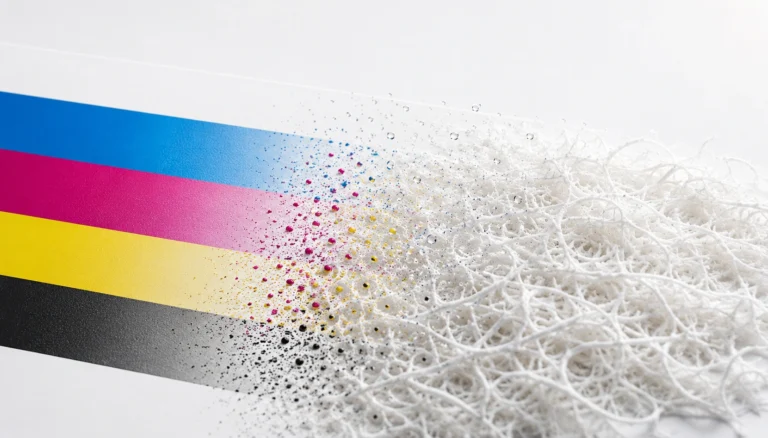


In standard offset printing, offset inks are typically used in four process colours —cyan, magenta, yellow and black— capable of reproducing a very wide colour gamut. But there are jobs where that is not enough. When a customer needs a gold that truly shines, a neon pink that stands out on the shelf or an invisible mark that helps verify the authenticity of a document, special inks come into play.
Special inks are those that go beyond CMYK: pigments and technologies designed to achieve what the standard process cannot deliver. They are not a luxury extra reserved for large projects. They are technical tools with specific applications that every printer should know and be able to recommend.
One clarification before we begin: Pantone inks, although they also go beyond the CMYK process, have their own identity as a standardised colour system and are not treated here as special inks in the strict sense.

Metallic inks: shine, coverage and perceived value
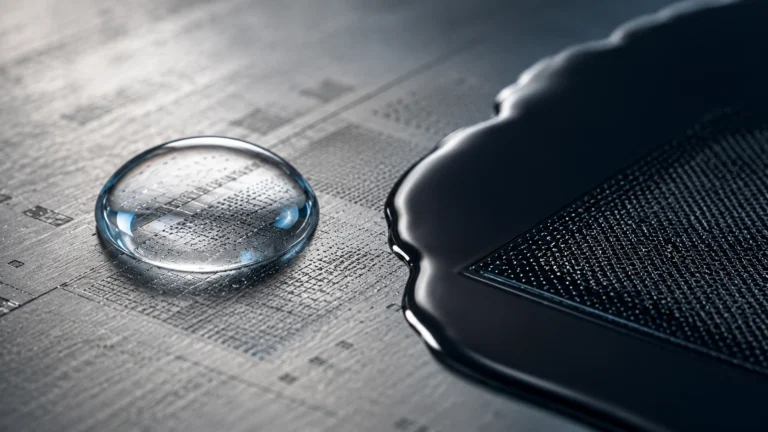
Metallic offset inks are formulated with metallic pigments —mainly aluminium for silver tones and bronze for gold tones— with an ultrafine particle size. It is precisely this particle size that determines the quality of the effect: the finer and more uniform the pigment, the greater the shine, tone purity and detail quality in print.
Unlike a conventional process ink, whose pigment absorbs and reflects light diffusely, metallic pigments reflect light specularly —like a mirror— generating that characteristic bright effect that no CMYK combination can faithfully reproduce.
Their applications are extensive in the world of premium packaging: wine and spirits labels, cosmetics, perfumery, toys, editorial covers and corporate projects where gold or silver forms part of the brand identity. These are inks that communicate value before the consumer reads a single word.
Metallic inks are also available in UV versions, both for conventional curing systems and for low-energy technologies —LED, LE-UV, H-UV—, expanding their possibilities to non-absorbent substrates and offering greater rub resistance from the very first moment. For food packaging where the printed side is not in direct contact with the food, low-migration formulations are available that meet the sector’s regulatory requirements.
At MA Inks, we offer metallic solutions for conventional offset and for UV and low-energy systems, including low-migration versions for indirect-contact food packaging.
Fluorescent inks: maximum visual intensity
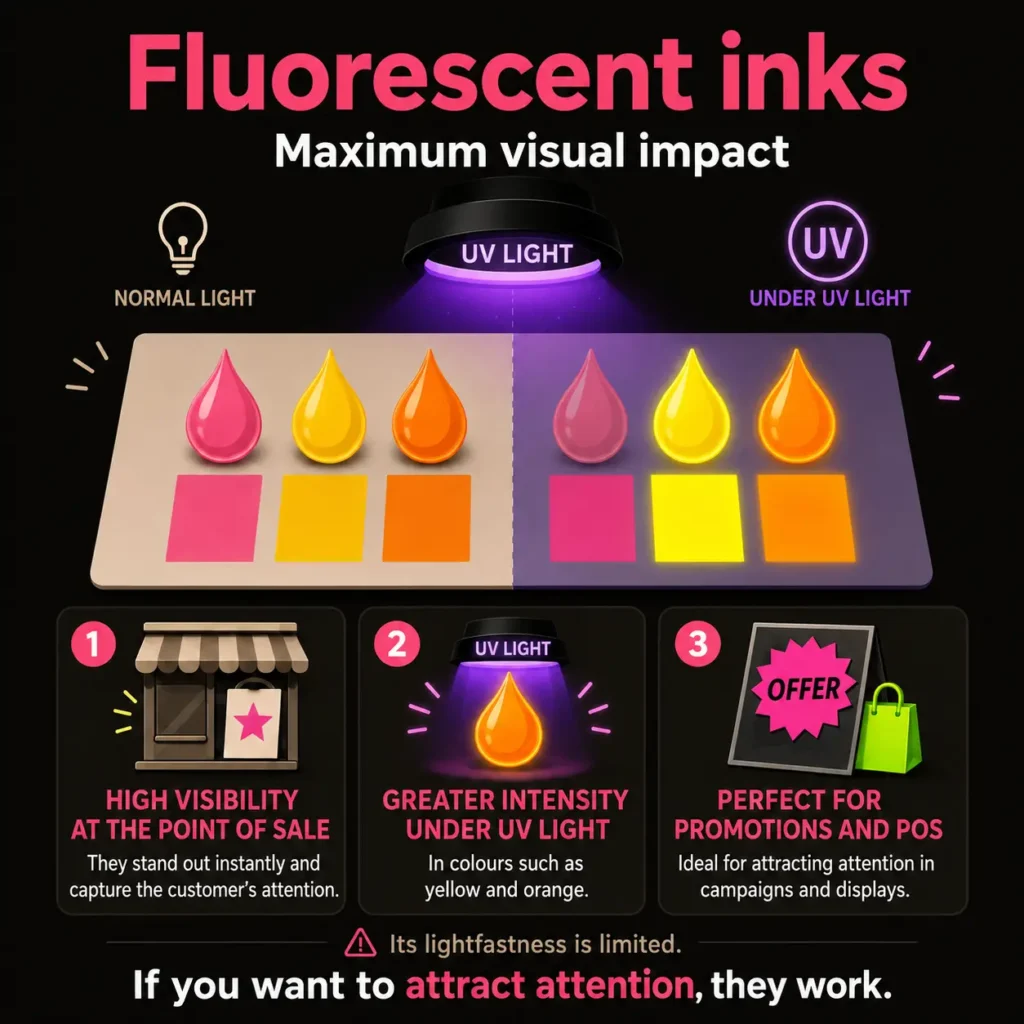
Fluorescent inks do not simply reflect light like any other ink: they absorb it at non-visible wavelengths —ultraviolet— and re-emit it at visible wavelengths, producing a colour intensity and vividness that no conventional ink can match. The effect is especially striking in environments with fluorescent lighting, although some bases —such as yellow and orange— also show luminescent behaviour under UV light.
Their applications range from eye-catching point-of-sale packaging to security and authentication elements in documents, tickets and banknotes. In editorial and advertising design, they open up unique creative possibilities for projects that require maximum visual impact.
The technical behaviour of fluorescent inks has one important characteristic that should be taken into account: their lightfastness is low. Fluorescent pigments are sensitive to degradation caused by prolonged exposure to sunlight or artificial light, making them less suitable for jobs with long-term outdoor exposure. For indoor or temporary-use applications —packaging, labels, promotional materials— this is not a practical problem.
At MA Inks, we offer fluorescent solutions for both conventional offset and UV and low-energy curing systems, with options suitable for absorbent and non-absorbent substrates.
To explore the technical behaviour of fluorescent inks in offset printing, their applications and usage recommendations in greater depth, you can read the full article we dedicated to this topic: Fluorescent inks in offset printing.
Security inks: ink as an authentication tool
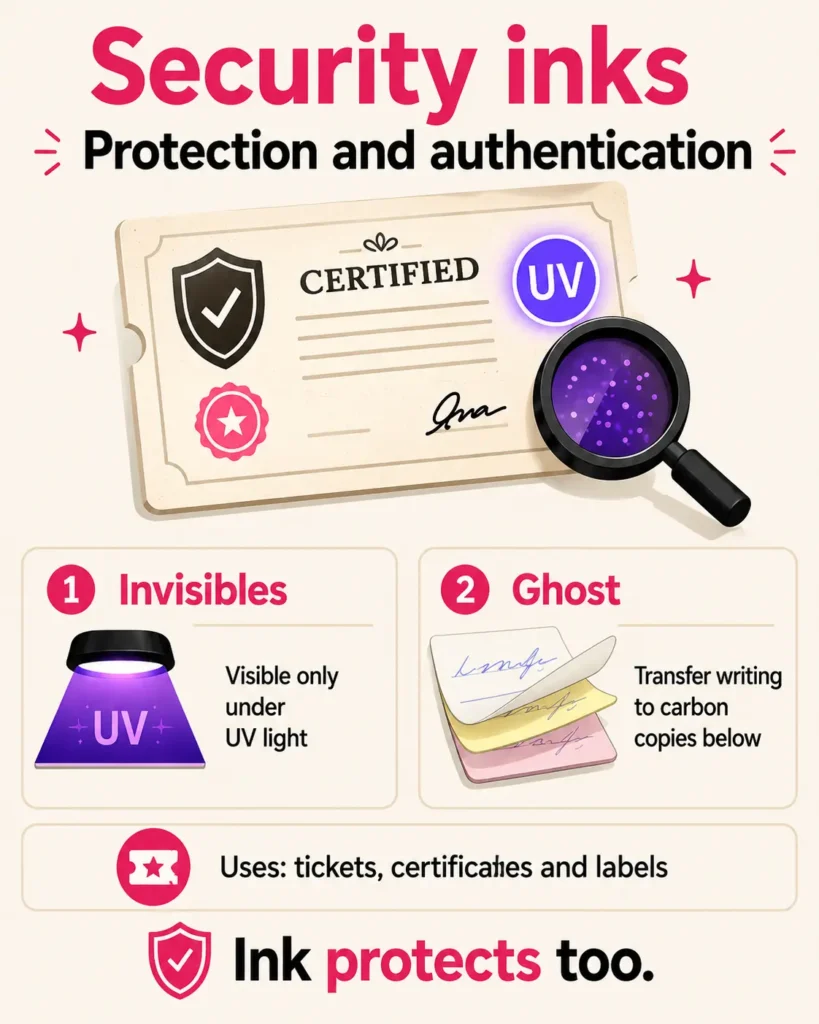
Security inks are a different field. Their purpose is not aesthetic, but functional: to make counterfeiting documents, packaging or printed products more difficult or impossible. These inks are designed to add an extra layer of control, verification or traceability to the printed product.
Invisible inks
Invisible inks are imperceptible to the naked eye under normal light but reveal their presence under UV light. For the effect to work correctly, it is important to use papers without optical brighteners, as these can mask the ink’s luminescence and make it harder to read. They are used in identity documents, lottery tickets, event tickets, certificates and authenticity labels, without interfering with the visual design of the document, while providing a security layer that can only be verified with the appropriate equipment.
Their use in pharmaceutical, cosmetic and high-end packaging is growing significantly, driven by the need to combat product counterfeiting in global markets.
Carbonless copy inks
Carbonless copy inks allow writing or pressure applied to one sheet to be transferred to one or more sheets underneath. They are used in forms, carbonless documents, receipt books, internal controls and applications where it is necessary to create a duplicate or multiple record of an operation. Within the field of security inks, they can form part of document systems that facilitate traceability and reduce the risk of manipulation or information loss.
Usage considerations
Security inks require careful management in the print shop. As products with specific authentication or traceability functions, their handling must ensure traceability and prevent any contamination that could compromise their function. Technical advice from the manufacturer is especially important in this case to ensure that the printing process preserves the properties of the ink.
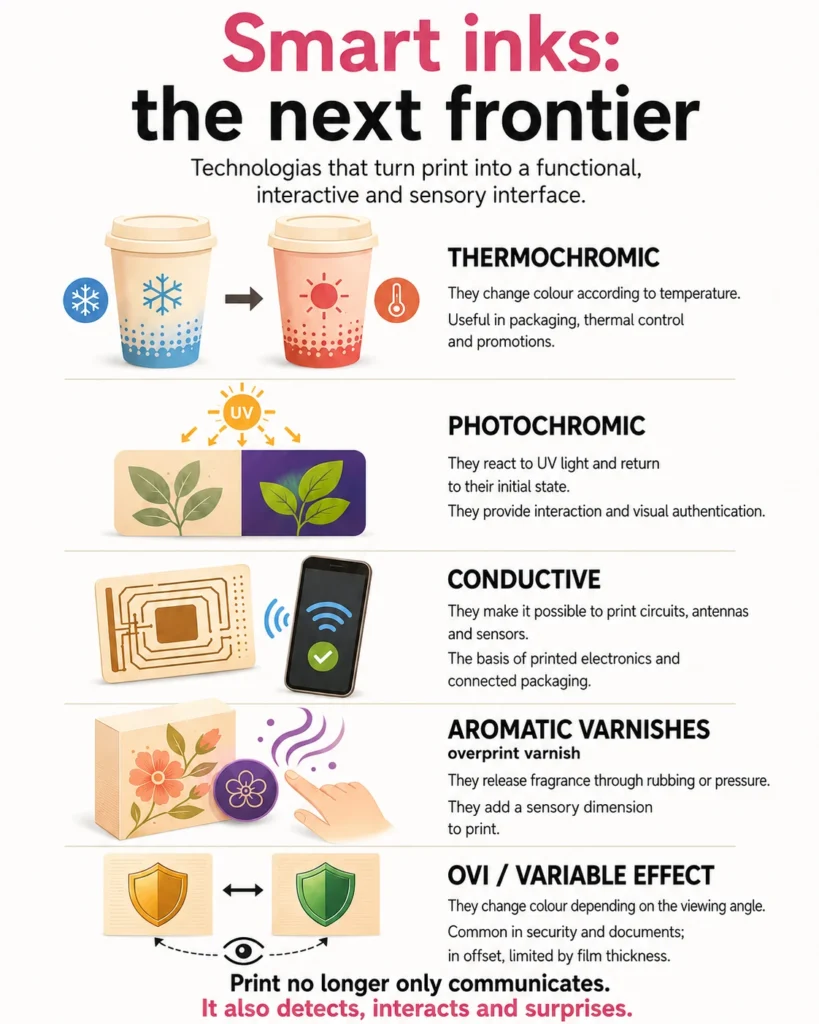
Smart inks: the next frontier
Metallic, fluorescent and security inks have been part of the workflow of many print shops for decades. But there is another group of inks that represents the most advanced frontier of what printing can do: functional and smart inks. Their presence in the offset market is still emerging, and in many cases their development is being driven by digital printing, flexography or electronics, but their potential in packaging, labelling and visual communication is enormous and worth understanding.
Thermochromic inks
Thermochromic inks change colour in response to temperature variations. They are formulated with microcapsules that, when they reach a specific thermal threshold, alter their structure and modify or make the colour disappear. When the temperature returns to the normal range, the ink recovers its original appearance.
Their most immediate applications are in food and beverage packaging —visual indicators of the optimal consumption temperature—, in control systems —elements that reveal information only under specific thermal conditions—, and in toys and promotional products where the colour change forms part of the user experience. Their ability to turn packaging into a functional indicator without the need for electronics or external sensors makes them especially interesting for brands seeking differentiation.
Photochromic inks
Photochromic inks react to light: under exposure to ultraviolet radiation, they change colour or intensify it, and return to their original state when the light source is removed. Unlike fluorescent inks, which simply emit what they absorb, photochromic inks produce a reversible and controlled chromatic transformation.
Their applications combine functionality with creativity: packaging with interactive visual effects, authentication elements that are only revealed under sunlight or UV light, and designs that change depending on the environment. The reversibility of the effect —something they share with thermochromic inks— opens up possibilities for interaction that conventional inks cannot offer.
Conductive inks
Conductive inks contain metallic particles —usually silver, copper or carbon— that allow electricity to be conducted across a printed surface. They are the basis of what is known as printed electronics: circuits, antennas, sensors and connectors integrated directly into paper, cardboard, film or other substrates.
In packaging, their applications are no longer science fiction: NFC labels that connect the package with the consumer’s smartphone, systems that detect whether a product has been opened or tampered with, temperature or humidity sensors printed directly onto the packaging. The connection between the physical printed object and the digital environment is the territory that conductive inks are making possible.
Aromatic varnishes
Technically, they are not inks but overprint varnishes, yet their effect deserves a place in any overview of the cutting edge of special printing. Aromatic varnishes release fragrance when rubbed or subjected to pressure, thanks to microcapsules that break through friction. They are already used in advertising, cosmetics and perfumery packaging, and promotional materials. They add a sensory dimension to the printed product that no visual resource can replicate: smell activates memory and emotion in a way that sight alone cannot.
Optically variable pigments (OVI)
Optically variable pigments —OVI, from Optically Variable Ink— produce a colour shift when the viewing angle changes. The same printed element can appear gold from one angle and green from another. Their best-known use is in banknotes and high-security identity documents, where they are one of the most difficult anti-counterfeiting elements to reproduce.
In offset printing, their application is limited by the thickness of the ink film that the process can transfer, which affects the final effect. Other systems such as screen printing or gravure offer better conditions for exploiting their full potential. In any case, also in premium packaging and luxury labelling, variable colour effects remain a high-impact visual territory when the technical conditions allow it.
Frequently asked questions about special inks in offset printing
Which substrate is most suitable for metallic inks?
High-gloss coated papers and boards offer the best result, because their smooth surface allows the pigments to align uniformly and maximise the specular effect. On uncoated or highly absorbent substrates, the metallic finish is significantly reduced.
Can metallic inks be combined with UV varnishes?
Yes, and it is a very common combination in premium packaging. Subsequent UV varnishing protects the metallic finish, improves rub resistance and makes it possible to create combined effects such as matte-gloss contrast over the metallic base.
Do fluorescent inks work the same way in conventional and UV printing?
Not exactly. Conventional fluorescent inks are used as spot colours in specific jobs. UV versions offer instant curing and greater resistance, and are the most suitable for non-absorbent substrates. In both cases, lightfastness is low, which must be taken into account depending on the application.
Can I use metallic inks in food packaging?
For food packaging applications, low-migration formulations are available for indirect-contact packaging. In these cases, the choice of ink must always be assessed together with the substrate, varnish, printing conditions and regulatory compliance of the final package.
Do special inks require any specific machine settings?
It depends on the type. Metallic inks require adjustments to ink laydown and are especially sensitive to the substrate. UV fluorescent inks require suitable curing systems. Security inks require specific handling and traceability protocols. In all cases, technical advice from the manufacturer before the first job is highly recommended.
Conclusion
Special inks are not a decorative extra. They are technical tools with very specific functions: adding perceived value to a product, creating visual impact, protecting documents and brands against counterfeiting, or incorporating functionalities into printed materials that, until recently, belonged to the field of electronics. Knowing them and understanding how to work with them is part of the technical background of any printing professional who wants to stay up to date.
If you have a project that requires metallic, fluorescent or security inks, contact our technical team and we will help you define the most suitable solution for your process and application.