


Introduction: Towards More Responsible Printing
Sustainability has become a central pillar in the printing industry. It is not just about choosing recycled papers or environmentally friendly inks: varnishes also play a key role in protecting printed materials and reducing the environmental impact of every project.
In offset printing, the choice of varnish can make the difference between a conventional package and one that complies with food regulations, reduces emissions, and adds value to packaging or printed communication. That is why talking about sustainable varnishes is talking about innovation, responsibility, and new opportunities for printers and brands.

What do we mean by sustainable varnishes?
A sustainable varnish is one that, in addition to fulfilling its technical and aesthetic function, is formulated to reduce its environmental impact. This can be achieved in different ways:
- With low volatile organic compound (VOC) content, as seen in water-based varnishes.
- Using raw materials of renewable origin, such as in BIO vegetable varnishes.
- Adapting to strict food safety regulations.
- Using raw materials that are environmentally friendly and technically effective.
In this way, sustainable varnishes constitute the most reliable alternative to conventional solvent-based varnishes.
Types of Sustainable Varnishes
Water-based varnishes
These are the most widespread in offset printing. They are applied in-line and stand out for their fast drying, low VOC emissions, and rub resistance. They can be formulated in low migration (LM) versions for food packaging and in barrier variants that provide protection against grease and moisture, helping to replace plastics in certain containers.
BIO Vegetable Varnishes
Made with vegetable oils and free of mineral oils, heavy metals, and PFAS. They offer matte, gloss, or silk finishes, low odor, and transparency, and can be applied both wet-on-wet (in-line) and wet-on-dry. They are an environmentally friendly alternative for multiple applications.
UV and UV Flexo Varnishes
They constitute another sustainable alternative, as they are free of mineral oils, heavy metals, and PFAS. Their curing by UV radiation allows for finishes of great resistance and durability, also optimizing energy consumption in modern equipment. They represent a reliable option for applications that demand high technical performance without giving up environmental commitment.
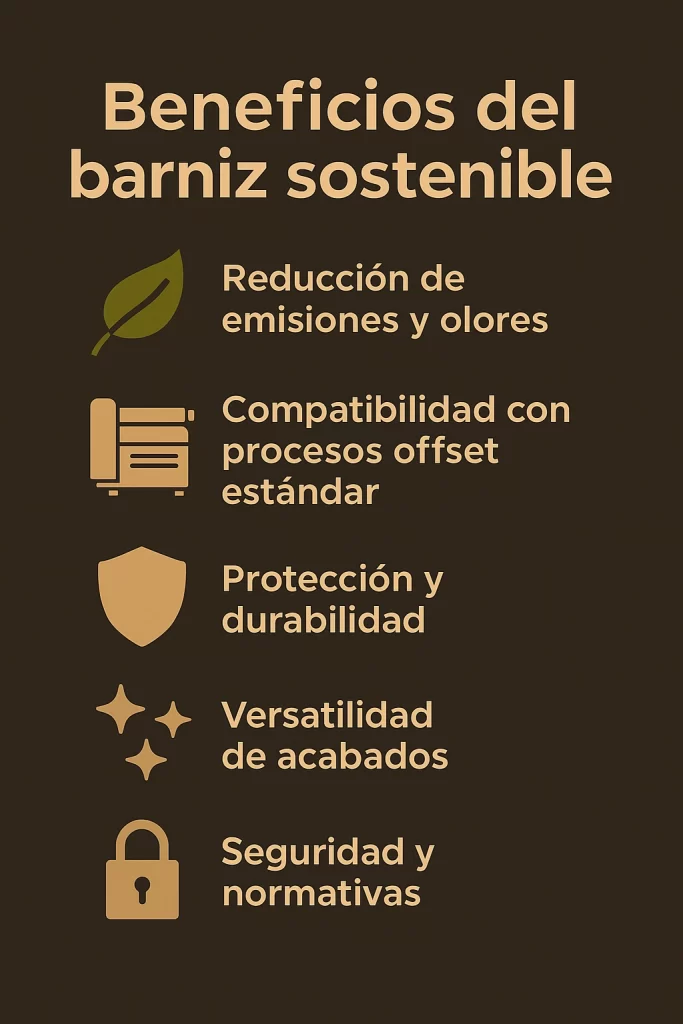
Benefits of Sustainable Varnishes in Offset
Reduction of Emissions and Odors
They significantly decrease VOC emissions and reduce odors in the work environment, improving air quality and contributing to cleaner processes.
Compatibility with Standard Offset Processes
They can be integrated into conventional offset machines without the need for major technical changes. This facilitates the transition towards a more responsible production.
Protection and Durability
They ensure resistance to rubbing, moisture, and common chemical agents, preserving the quality of the print throughout its life cycle.
Versatility of Finishes
They allow for a choice between gloss, matte, or silk finishes, as well as total or selective applications to highlight design elements.
Safety and Regulations
Many of these varnishes have been validated for indirect food contact. They comply with the Swiss Ordinance and Regulation 10/2011 and have been manufactured according to the Good Manufacturing Practices (GMP) of EuPIA GMP, which guarantees safety and trust for brands and consumers.
There are also barrier solutions for the food sector, aligned with current regulatory requirements.

Applications in Packaging and Publishing
The use of sustainable varnishes is especially relevant in sectors where safety and consumer perception are key. Each application demands different technical requirements, which these varnishes can cover effectively.
- Food Packaging: includes cereal boxes, cookie boxes, pastry trays, or ready-meal containers. In this field, grease and moisture barrier solutions are essential to preserve the product and, at the same time, replace additional plastic materials. It is also common to use Low Migration varnishes for packaging in indirect contact with food.
- Cosmetics: high-value-added packaging where aesthetics and safety are fundamental. Matte, gloss, or silk finishes convey prestige and differentiation at the point of sale.
- Publishing and Commercial: catalogs, magazines, and brochures that seek to stand out both in visual quality and environmental responsibility. A glossy varnish intensifies colors, while a matte one provides sobriety and elegance.
- Corporate and Promotional Material: annual reports, sustainability reports, or marketing material, where the use of sustainable varnishes provides consistency between the content and the physical support.

The MA Inks Range of Sustainable Varnishes
At MA Inks, we have developed a wide range of varnishes that combine performance and sustainability. Below they are detailed in more depth, highlighting the most relevant characteristics gathered from their technical data sheets:
Water-based Varnishes
- Water Based Coating Gloss: White acrylic varnish with a refined appearance, designed to create a glossy finish. Its formulation ensures fast drying and high rub resistance.
- Water Based Neutral Coating LM 5111: Low migration acrylic varnish that provides a neutral finish on the print. Designed for commercial and packaging work, it is also suitable for food packaging in indirect contact.
- Water Based Matt Coating: Acrylic varnish with a matte effect, offering very good drying and rub resistance. Especially useful in commercial and packaging applications.
- Water Based Extra Gloss Coating Single Side: White acrylic varnish that provides a very high gloss effect on one side. Its composition guarantees fast drying and great rub resistance.
- Water Based Coating Gloss LM: Low migration glossy acrylic varnish, with optimal drying and resistance properties. Suitable for commercial and packaging printing, and also for food packaging with indirect contact. ISEGA certified.
- Water Based DFC Barrier Coating: Acrylic varnish that provides a glossy finish, acting as a barrier against grease and water, and suitable for direct food contact.
- Water Based High Gloss Ink Duct Varnish: High gloss acrylic varnish, designed to be applied directly from the ink duct with great stability. It allows taking advantage of all the benefits of water-based varnishes without the need for a coating unit. Its fast drying and high rub resistance facilitate reaching high production speeds and reduce times between printing and finishing.
- Water Based Matt Ink Duct Varnish: Matte acrylic varnish, also formulated for application from the ink duct with great stability. It offers the advantages of water-based varnishes without requiring a coating unit. Its fast drying and good rub resistance allow maintaining high machine speeds and minimizing finishing times.
BIO Overprint Varnishes
- BIO Overprint Matt Varnish: Sheet-fed offset varnish that offers great resistance in printing and a matte finish. Transparent, with low odor and color, it can be applied in spot or full background both wet-on-wet (in-line) and wet-on-dry. Made with vegetable oils and free of mineral oils, heavy metals, and PFAS.
- BIO Overprint Silk Varnish: Sheet-fed offset varnish that combines high printing resistance with a semi-matte finish. Transparent, low odor and color, applicable in spot or full background in wet-on-wet (in-line) or wet-on-dry. Made with vegetable oils and free of mineral oils, heavy metals, and PFAS.
- BIO Overprint High Gloss Varnish: Sheet-fed offset varnish that provides great resistance and a high gloss finish. Transparent, with low odor and color, it can be applied in spot or full background both wet-on-wet and wet-on-dry. Made with vegetable oils and free of mineral oils, heavy metals, and PFAS.
Low Migration Overprint Varnishes
- Overprint Varnish LM: Oil-based overprint varnish with low migration formulation. It is specifically designed for food packaging where the varnished surface is in indirect contact with the food. It provides a glossy finish.
- Overprint Matt Varnish LM: Low migration oil-based overprint varnish, also created for food packaging with indirect contact of the varnish with the food. It offers a matte finish.
Conclusion
Sustainable varnishes, whether water-based or vegetable, lead the way towards cleaner, safer, and more responsible offset printing. Thanks to their innovation and reliability, they allow for protecting prints, offering high-quality finishes, and responding to the growing demand for sustainability in the market.
At MA Inks, we work every day so that printers and brands have solutions that combine technical performance and environmental respect. If you want to take a step forward towards sustainable printing, get in touch with us and discover how our varnishes can transform your projects.