

In a market increasingly oriented towards environmental responsibility, choosing sustainable packaging ink is no longer an option, but a necessity. Brands are looking for solutions that not only comply with current legislation, but also reinforce their environmental commitment. In this context, the inks used in packaging make a significant difference in terms of recyclability, compostability, and consumer safety.
At MA Inks, sustainability is a strategic R&D&I line reflected in our technical solutions for offset printing. Below, we explore the key principles of sustainable packaging, the legal framework that regulates it, and how our inks are aligned with this global shift.
What is sustainable packaging and how has it evolved?
The concept of sustainable packaging has evolved significantly in recent years. Traditionally, packaging was designed exclusively for logistical and marketing purposes, without considering its environmental impact.
Today, sustainable packaging is understood as packaging that:
- Is designed to minimize environmental impact throughout its entire life cycle.
- Uses renewable, recyclable, biodegradable, or compostable materials.
- Promotes energy efficiency in its production.
- Is safe for both the consumer and the environment.
Sustainable packaging begins with the ink: key to a circular economy
The circular economy is not just a production philosophy: it is a concrete strategy that begins at the design stage and is reactivated at every phase of the product life cycle, from use to recycling, reuse, or composting of the packaging.
For packaging to be truly sustainable, all its components must be aligned with this vision. And this decisively includes the ink.
-
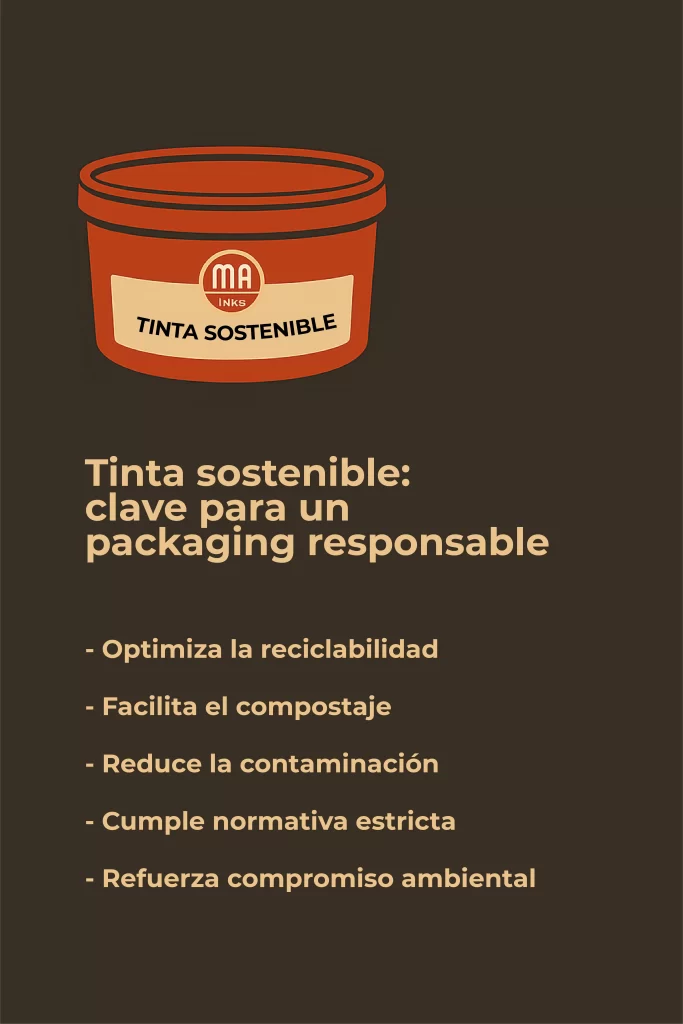
An ink containing heavy metals or mineral oils can hinder the recycling of paper or cardboard.
-
If it does not meet compostability criteria, it prevents compostable packaging from truly being compostable.
-
If it is not formulated under safety standards, it may limit the reuse of recycled materials in sensitive applications such as food or cosmetics.
👉 Sustainability starts with the ink.
At MA Inks, we develop sustainable inks that not only meet the most demanding quality standards, but also facilitate the closing of the loop and enable our clients to become active agents of the circular economy.

Regulatory framework for sustainable inks and packaging: safety and legal compliance
The regulations governing packaging and inks are becoming increasingly strict. MA Inks operates in compliance with the most relevant certifications and regulations in the graphic and sustainable packaging industry:
- EuPIA Exclusion Policy: prohibits the use of certain hazardous substances in inks to protect human health and the environment.
- Directive 94/62/EC: regulates packaging and packaging waste, limiting the use of heavy metals.
- Standard EN 71-3:2019: related to chemical safety in printed products for children.
- REACH Regulation (EC 1907/2006): controls the use of chemical substances in the industry.
- Regulation (EC) 1935/2004: applicable to materials in contact with food.
- Regulation 10/2011 and Swiss Ordinance: regulations governing the use of certain substances in inks intended for indirect food contact packaging.
- Standard EN 13432:2001: certifies the industrial compostability of printed materials.
Compliance with these regulations not only avoids penalties, but also increases consumer confidence and facilitates export to demanding markets.

Key factors for choosing sustainable packaging inks
Choosing a sustainable packaging ink is not limited to color or performance, but involves making informed decisions that directly impact recyclability, compostability, and product safety. To select an ink truly aligned with ecological packaging principles, it is essential to consider the following factors:
- Ink composition: priority should be given to inks formulated with vegetable oils rather than petroleum derivatives, as well as inks free from heavy metals, PFAS, and other substances that may affect the packaging life cycle.
- Low migration: especially in packaging intended for food or cosmetics, compliance with current migration regulations is essential.
- Sustainability standards and certifications: preferential use of inks certified according to standard EN13432:2001 and that have passed deinking tests such as INGEDE 11, which promote proper packaging recycling.
- Compatibility with sustainable substrates: the ink must be suitable for recyclable, biodegradable, or compostable materials without interfering with their recovery processes.
The combination of these factors ensures that ink selection is not only technically effective, but also environmentally and legally responsible.

MA Inks: your partner in the ecological transition
At MA Inks, we are committed to cleaner, safer, and more responsible printing. Our R&D&I department actively works on developing sustainable packaging inks formulated without harmful substances, compliant with current regulations, and providing technical value to the most demanding printers.
Are you looking for a sustainable packaging ink that combines performance, regulatory safety, and environmental responsibility? Contact our technical team at info@ma-inks.com or visit our website: www.ma-inks.com and discover how we can help you develop responsible and high-impact packaging.