
The printing industry has evolved by leaps and bounds in recent years. Printing presses are becoming faster, printing substrates are more diverse and demanding (from papers and boards to non-porous and highly specialized materials), and environmental requirements are stricter. In this scenario, ink manufacturing has ceased to be a purely artisanal trade to become a high-level chemical engineering discipline.
For an offset ink manufacturer, the challenge is permanent: obtaining maximum chromatic intensity with minimum ink input, ensuring fast drying without sacrificing gloss, achieving almost perfect dot sharpness, and guaranteeing consistent performance in a printing house in Germany as much as in one in Brazil, despite their different temperature and humidity conditions.
At MA Inks, we produce more than 5,000 tons of ink annually. This figure is not just an indicator of volume, but of the trust that the global market places in our consistency. To reach this production level without sacrificing quality, we fuse cutting-edge technology with high chemical engineering, guaranteeing predictability and consistency in every batch.

The Brain of the Operation: Laboratory, R+D+i, and the Science of Color
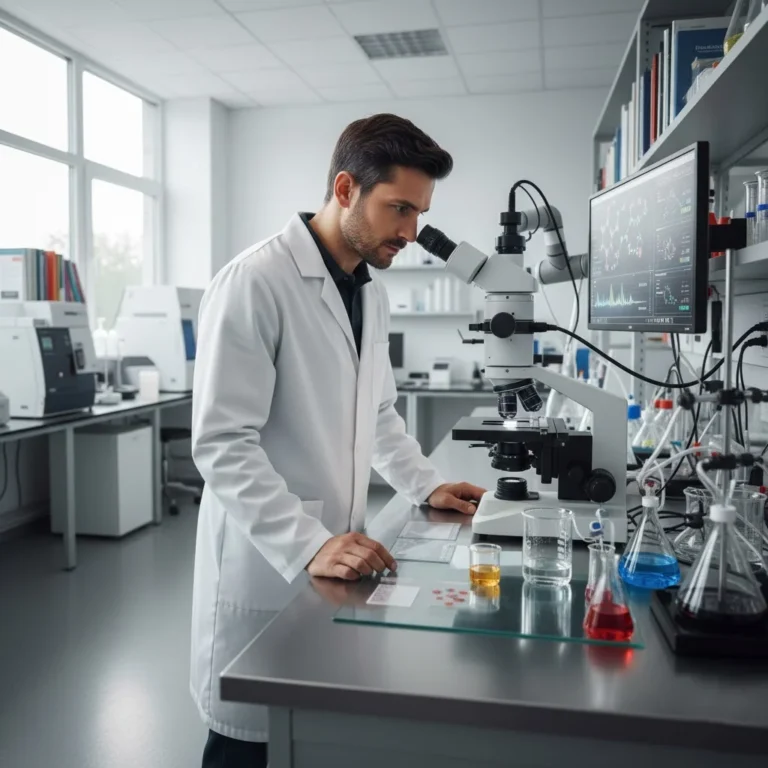
Often, when we think of ink manufacturing, the image that comes to mind is that of industrial tanks, powerful mixers, and busy operators. However, the true differential value of a top-tier offset ink manufacturer lies in its intellectual and scientific capacity: its laboratory. This space is the true engine of Research, Development, and Innovation (R+D+i) at MA Inks and where the chemical strategy is mapped out. The team works on three fundamental fronts that, although invisible in the final product photo, are absolutely vital for printed performance:
Tailor-made Formulation and Design
Every ink is first born as an idea and a theoretical formula. Our chemists develop specific “recipes” for every need. Formulating an ink that must dry instantly on high-speed gloss coated paper is not the same as formulating one that must resist humidity and freezing for a cardboard food package. This is where specific resins, vegetable oils, and technical additives are selected. We do not use generic formulas: we design the chemical architecture of the ink so that the performance on the customer’s machine is optimal.
Raw Materials Control
The quality of the final product inevitably depends on the quality of the ingredients. Before any bag of pigment or oil tank enters our production plant, it passes through a strict filter in the laboratory. We analyze the purity, concentration, and physicochemical properties of every batch of raw material. If an ingredient does not meet our strict standards of excellence, it is automatically rejected. This is what ensures that our inks are always stable and predictable, batch after batch.
Advanced Colorimetry
The human eye is a wonderful tool, but subjective and fallible. In the laboratory, we use state-of-the-art spectrophotometers to measure color with mathematical precision, using metrics such as Delta E (this metric quantifies the difference between two colors, a reference and a sample; the closer it is to zero, the smaller the deviation). This allows us to ensure that critical brand tones (or special colors) are identical whether they are printed today, tomorrow, or six months from now, regardless of external conditions.
The Offset Ink Manufacturing Process: From Formula to Packaging
Once the laboratory has validated the formula and certified the raw materials, the production phase begins. Execution on the plant floor is the industrial application of that chemical precision. From initial weighing to final packaging, every stage of the process is crucial to transform the formulation into high-performance offset ink.

Batch Preparation: Weighing and Pre-mixing Components
The actual ink production phase begins with batch preparation. Following the strict recipe established by the laboratory, our technicians proceed to weigh and pre-mix the fundamental components. It is a delicate moment where proportions must be exact:
-
Pigments (The Strength of Color): They are the element that defines tone and opacity. Beyond their chemical nature, pigment quality is crucial for the tinting strength and chemical resistance of the final print. They are dosed with millimeter precision.
-
Vehicles or Resins (The Physical Skeleton): They are the matrix that encapsulates the pigment. Their main function is twofold: guaranteeing uniform rheological transfer through the machine rollers and firmly fixing the pigment to the substrate to achieve the desired gloss and rub resistance.
-
Oils (The Engine of Drying): They act as the resin’s solvent agent, defining viscosity and drying speed. We use renewable vegetable oils as a priority base, as their physicochemical properties contribute to better absorption and curing, optimizing final performance.
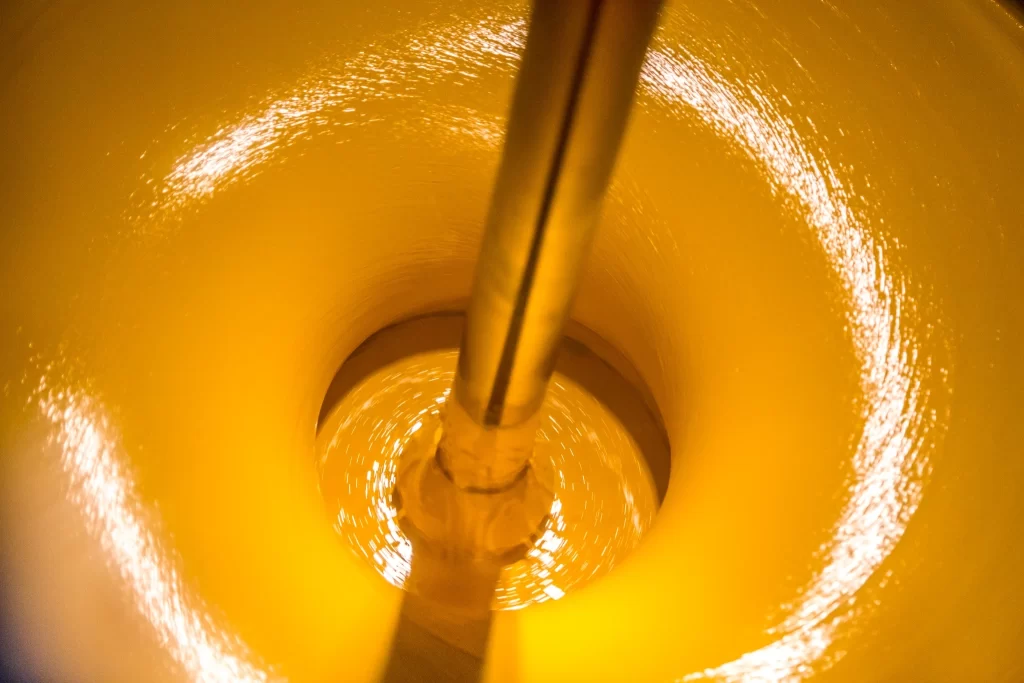
At this stage, the components are mixed in industrial vats to create a homogeneous paste. Although it already has the desired color, this paste is still rough and grainy; it will serve as the base for the next crucial step.
Three-Roll Milling: Where True Quality is Born
If there is a phase that defines the mechanical and technical quality of an ink manufacturer, it is undoubtedly Milling. The pre-mixture obtained in the previous phase contains pigments grouped in “clusters” or microscopic agglomerates. If the ink were used in this state, not only would color strength be lost, but abrasive particles would damage the printing plates.
To solve this, the mixture passes through the three-roll mill. As its name suggests, this machine consists of three high-precision hardened steel rollers that rotate at different speeds and in opposite directions. This generates immense shear, friction, and pressure between the rollers.
The goal here is not to “crush” the pigment (which is already a fine powder), but to disperse it perfectly. This involves two key actions: wetting each particle with the vehicle (varnish) and breaking the agglomerates to reduce the particle size to microns (thousandths of a millimeter).
Quality Control: The fineness of the dispersion is continuously verified in the laboratory with a grindometer, ensuring that the particle size is optimal for performance.
The result is a fine and perfect dispersion that guarantees maximum color intensity, greater transparency for process color (CMYK) overlays, and superior gloss.
Batch Completion
After passing through the three-roll mill, we obtain the grinding base, which is essentially a pigment concentrate. It is a paste of extremely high color density and very high viscosity, too strong to be used directly on the press.
In the “Completion” phase (or Let-Down), this base is transferred to larger capacity tanks. The goal is to incorporate the final volume of the let-down varnishes. These varnishes have a crucial dual function: adjusting the tinting strength (color density) to the final specification and reducing viscosity so that the ink flows correctly on the rollers.
This process is critical and delicate. Agitation must be intense enough to guarantee perfect dilution and homogeneity, but without generating excessive shear that could lead to the re-agglomeration of pigment particles that were dispersed with such effort during milling. It is here where the mixture begins to take on the rheological properties and color concentration of the final product.
Mixing of the Completion and the Ink: The Science of Rheology
If milling was a purely physical process, this phase is pure chemistry and rheology (the study of how fluids flow and deform). In large industrial mixers, we add the specific technical additives that the laboratory has prescribed to give the ink its “personality” and press behavior:
-
Additives: Driers for oxidation, waxes to improve rub resistance and antioxidants, vital to prevent the ink from drying on the press rollers.
-
Rheological Behavior: Offset ink is a non-Newtonian fluid. It must be thixotropic (rigid at rest) and pseudoplastic to become fluid instantly under the high shear of the rollers, guaranteeing efficient transfer.
Validation and Final Quality Control
Before finishing this phase and proceeding to packaging, the laboratory intervenes critically again. A sample is taken from the tank and three sacred parameters are verified: Viscosity, Tack, and Tone.
-
The Emulsion Challenge: A fundamental aspect of this validation is the water balance. The ink must have the precise surface tension to accept only the minimum amount of water (avoiding “chalking”) and thus guarantee maximum color intensity.
Packaging: Technology and Preservation
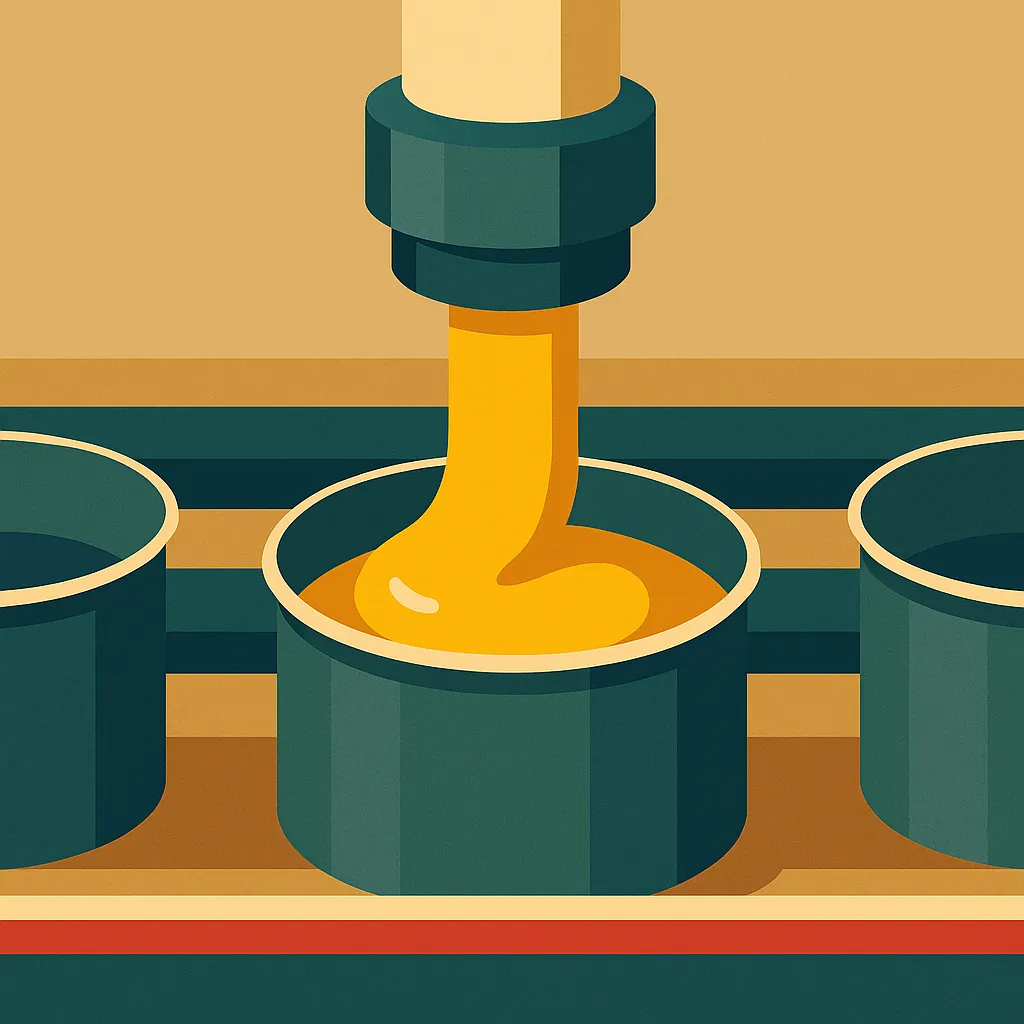
Once the final formula is validated, the ink passes to automated packaging lines. The packaging process is carried out under controlled conditions, using vacuum or pressure filling systems that prevent air bubbles from getting trapped. This ensures that the ink is fresh, without the annoying “skin,” and ready to offer maximum performance.
Warehouse and Shipping: Global Logistics from Murcia
The final phase of the cycle occurs in our shipping warehouse. From our plant in Totana, we manage a complex logistics network that takes the “Made in Spain” brand to five continents. Being a global ink manufacturer implies mastering international transport regulations for chemical goods, ensuring the product reaches more than 60 countries.
MA Inks Commitment: The Pillars that Define Us
Our success and growth are not accidental, but the result of our firm commitment to excellence. Behind every can of ink, there is a commitment that materializes in these fundamental pillars:
Rigor and Quality Through Our Human Team
We know that our staff is our greatest strength. Every member of the team contributes their experience and passion to offer the best. This collective commitment guarantees that our standard of maximum quality is non-negotiable, consolidating a strict discipline applied from raw material control to rheological analysis. We thus ensure the consistency and predictability of ink performance batch after batch.
High-Precision Systems and Chemical Innovation
Cutting-edge technology is at the heart of everything we do. We work with advanced tools and innovative processes to develop inks and varnishes that respond to the most demanding needs of the printing industry. The use of High-Precision Systems allows exact control of dispersion and formulation, achieving leading solutions such as the HTK Series for difficult substrates, adapting the ink to the most modern printing systems.
Leadership in Sustainability and Environmental Commitment
Our commitment to the environment is a fundamental pillar in all our activities. We use raw materials with low ecological impact, production processes optimized to minimize waste, and renewable energies. This commitment is backed by ISO 14001 certification, reflecting our continuous improvement in responsible management. At MA Inks, we actively promote more sustainable and safer printing, free of sensitive components such as cobalt and MOSH/MOAH.
Attention to Each Customer, in Every Project
We strive to be our customers’ strategic ally in every project. We offer personalized solutions and specialized technical service that guarantees exceptional results. We position ourselves as the premium partner for professionals, offering specialized assistance and proactive support to optimize performance directly on the printer’s press. We seek to exceed the expectations of our customers in every collaboration.
Conclusion
Offset ink manufacturing is, ultimately, a perfectly synchronized dance between laboratory science and the power of heavy industry. It is not just about mixing colors; it is about guaranteeing consistency, printability, gloss, and sustainability in every batch.
At MA Inks, we are deeply proud to take color and printing expertise from Totana to the rest of the world. If you are looking for a strategic partner who understands your printing needs, speaks your language, and offers you a product backed by research and the most advanced technology, MA Inks is your home.
We invite you to discover the difference that printing with inks manufactured with the strictest scientific precision and time-honored artisanal passion makes.