


In an environment saturated with visual stimuli, offering printed solutions that effectively stand out has become a true challenge for the graphics industry. The fluorescent inks for offset printing represent a high-impact technical tool that allows printers, designers and brands to achieve products with added value that is difficult to match. This article analyzes in detail what these inks are, how they work, their main applications, and the technologies that make them essential in the workshop of professional printers seeking to differentiate their work.

What are fluorescent inks?
The fluorescent inks contain special pigments capable of absorbing ultraviolet (UV) radiation, invisible to the human eye, and transforming it into visible light. This phenomenon, known as fluorescence, generates exceptionally bright, saturated and luminous colors, impossible to achieve with conventional inks.
These colors cannot be reproduced using the CMYK color model, which uses cyan, magenta, yellow and black to create most tones in offset printing. For this reason, fluorescent inks are applied as spot colors, specially formulated to offer a color range beyond the reach of the standard system. They are ideal when seeking maximum visibility and visual impact.
Technical note: due to the nature of the pigments, these inks tend to have lower light resistance. This means they may fade over time if exposed to direct sunlight for long periods. Therefore, they are recommended for products with a short or medium lifespan.

How do fluorescent inks behave in offset printing?
The use of fluorescent inks in offset printing requires taking into account a series of technical particularities that differentiate them from conventional inks. These characteristics affect both the visual result and press behavior and are key to ensuring successful application.
- Unique brightness and vibrancy: fluorescent pigments have the ability to absorb ultraviolet radiation and emit visible light, generating a highly intense visual effect. This property gives them a special luminosity that stands out even in low-light conditions. The result is a color apparently illuminated from within, which immediately captures the observer’s attention.
- Uniform application and press behavior: in conventional versions, especially those formulated with vegetable oils, fluorescent inks provide good wetting and definition on the substrate. This makes them suitable for jobs where they are combined with pastel or other special inks. However, due to the nature of their pigments, fine adjustments in ink feed or pressure may be required to achieve a uniform result.
- Fast and efficient UV curing: UV-curable versions, such as the UV OFFSET FLUOSMART and UV PACK H-ECO FLUORESCENT ranges from MA Inks, are designed to solidify instantly when exposed to ultraviolet lamps, whether conventional or low-energy LED. This allows printing on non-absorbent substrates (plastics, synthetics, metallized materials), reduces production times, and minimizes post-printing handling issues.
- Compatibility with a wide range of substrates: these inks are formulated to perform correctly on both coated and uncoated papers. In the case of synthetic or special substrates, proper pretreatment (corona, plasma, or primer) is important to ensure optimal adhesion and prevent drying or anchoring defects.
Technical recommendation: the behavior of fluorescent inks may vary significantly depending on printing speed, machine type, dampening system, and substrate used. Therefore, preliminary tests are recommended before long runs or complex jobs, especially when printing on non-conventional substrates or at high speeds. This allows proper adjustment of parameters such as density, registration, and drying, ensuring final print quality.
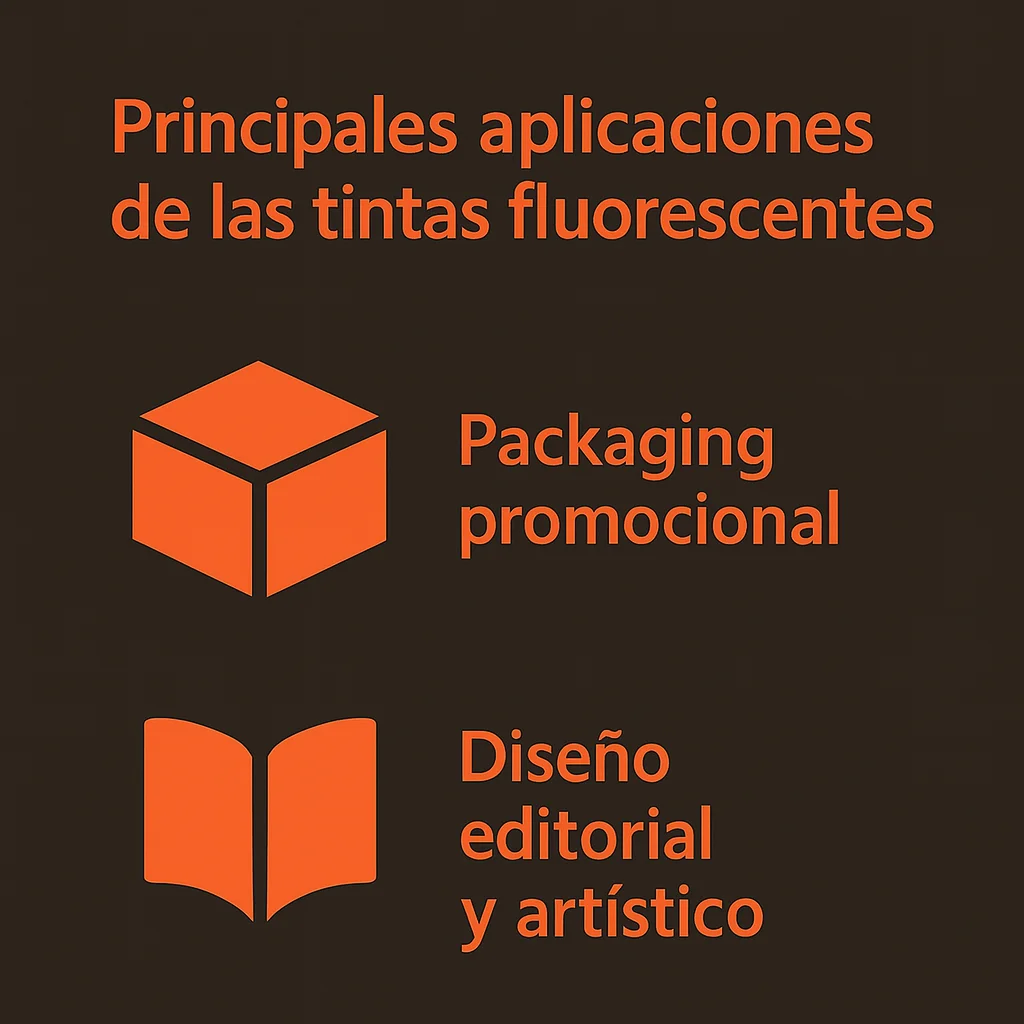
Main applications of fluorescent inks
Promotional packaging with fluorescent inks
Seasonal marketing campaigns or exclusive product launches benefit greatly from the visual impact of these inks. A fluorescent package can become the perfect attention-grabber on a supermarket shelf or in a boutique.
Editorial and artistic design with fluorescent inks
From illustrated books to concert posters, exhibitions, or artistic editions, these inks provide a bold and contemporary visual language. Many designers combine them with dark substrates or special papers to maximize contrast.
Real use cases of fluorescent inks
The fluorescent inks stand out for their unique ability to capture attention and generate visual impact. Their luminosity and vibrancy make them highly valued by professionals in design, advertising, and packaging. Over the decades, these inks have found applications across diverse sectors, from art and popular culture to the sports industry and retail. Below, we review some emblematic examples showing how these inks have been used to enhance visual communication and create memorable products.
Artistic movements:
Fluorescent inks have been a key resource in various artistic and cultural movements over time. In the psychedelic art of the 1960s, their chromatic intensity helped create posters and artworks that challenged visual norms, enhancing sensory impact and perception. During the 1990s, electronic music posters, especially in genres such as techno or rave, adopted fluorescent inks as a symbol of a vibrant, nocturnal aesthetic linked to club culture. Today, urban art and contemporary muralism also experiment with these colors to stand out in visually saturated urban environments.
Sports industry:
In sports marketing, major brands such as Nike, Adidas or Puma have integrated fluorescent inks into their packaging and product design strategies. Special edition shoe boxes, technical apparel packaging, or promotional catalogs use these colors to convey energy, dynamism, and innovation. The use of fluorescent inks helps associate the product with values such as speed, performance, and innovation.
Contemporary graphic design:
Modern graphic design continues to explore the potential of these inks in multiple applications. Independent publications such as Posterzine, design magazines, art catalogs, or limited edition editorial collections use fluorescent inks to differentiate themselves from conventional offerings and create products with a high perceived value. These inks are often combined with specialty papers or techniques such as foil stamping or spot varnishing to achieve even more spectacular results.
Retail and storefronts:
The retail sector uses fluorescent inks in point-of-sale materials (POS) and in storefront decoration to capture consumer attention and reinforce seasonal campaigns or special launches. In highly competitive environments such as shopping centers or trade fairs, these inks are a highly effective differentiation tool.
Cultural note:
At international trade fairs such as DRUPA or Graphispag, live demonstrations with specialty inks become one of the main attractions for visitors. Stands using these inks not only showcase printing technology but also explore their expressive potential, especially when combined with special finishes such as UV varnishes, metallic foils, or textured papers. These events serve as trend showcases and key references for professionals worldwide.

Eco-friendly fluorescent inks: sustainability and high visual impact
The use of fluorescent inks is compatible with environmental responsibility. In recent years, formulation advances have made it possible to develop solutions that combine high visual performance with sustainability criteria, especially relevant in sectors such as responsible packaging, institutional communication, or eco-focused promotional campaigns.
- Mineral oil-free formulation: conventional fluorescent inks from MA Inks eliminate aromatic mineral oils, using vegetable oils as their base instead. This formulation significantly reduces environmental impact and improves biodegradability of the printed product.
- Low-energy LED curing: advanced UV ranges such as UV PACK H-ECO FLUORESCENT are designed to operate with LED lamps, resulting in lower energy consumption, longer curing system lifespan, and elimination of ozone emissions or gas extraction requirements.
- Regulatory compliance: all MA Inks fluorescent inks are developed under the standards of the EuPIA (European Printing Ink Association) and comply with regulations such as REACH and Directive 94/62/EC on packaging and packaging waste. This ensures they can be safely used in commercial, promotional, and even food-related applications (subject to substrate and printing method validation).
The result is a range of sustainable fluorescent inks that not only offer extraordinary visual impact but also allow brands and printers to advance toward eco-efficiency goals without sacrificing creativity or technical quality.
MA Inks fluorescent inks: our solutions
At MA Inks, we offer offset printing professionals three main ranges of fluorescent inks, designed to cover different technologies and production needs:
PANTONE® Fluorescent Colors (conventional):
This range includes inks with a high pigment concentration, manufactured using vegetable oils and free of MOSH and MOAH. Formulated with fluorescent pigments approved by PANTONE®, they are suitable for direct use or for creating colors according to the Pastels & Neons guide in sheetfed offset printing.
UV PACK H-ECO FLUORESCENT PANTONE® COLORS:
Ink designed for curing with low-energy systems such as LED, HR, LE-UV, or H-UV. Thanks to its ultrafine fluorescent pigments, it ensures excellent adhesion on most non-absorbent substrates, stable press performance, and a clean, bright fluorescent effect.
UV OFFSET FLUOSMART PANTONE® COLORS:
Series developed for conventional UV curing, also formulated with ultrafine pigments. These inks provide excellent adhesion on different non-absorbent materials, high printing performance, and a pure, luminous fluorescent finish.
Fluorescent inks: technical references and standards
The use of fluorescent inks in offset printing is not only an aesthetic choice but also requires compliance with standards that guarantee quality, safety, and suitability of the final product. These technical references ensure inks meet requirements for resistance, safety in specific applications such as packaging, and color consistency, all essential in professional environments. Below is a summary of the main applicable standards and systems.
| Standard / System | Description | Application in fluorescent inks |
|---|---|---|
| PANTONE® Pastels & Neons System | Standard palette of fluorescent spot colors. | Defines the color range used by designers and ink formulators. |
| ISO 2836 | Determines ink resistance to solvents (alcohol, alkalis, etc.). | Important to ensure colors do not dissolve after printing. |
| ISO 12040 | Evaluates ink lightfastness. | Fluorescent inks generally have lower resistance under this standard. |
| EuPIA | Association establishing best practices and safety standards in printing inks. | Certifies formulations are safe, especially for packaging. |
| Directive 94/62/EC | European directive regulating heavy metal levels in printed packaging. | Ensures fluorescent inks are suitable for packaging printing. |
Conclusion
The fluorescent inks in offset printing are much more than a striking visual resource: they represent an effective technical solution to add value to printed materials, strengthen visual communication, and offer differentiated products to customers. Their versatility and impact make them an essential ally for professional printers seeking quality, reliability, and unique results in every project.
At MA Inks we offer fluorescent ink ranges that combine high performance, regulatory compliance, and solutions adapted to different offset printing technologies. Contact us to receive specialized advice and discover the best option for your projects.