

Origin: from lithography to offset
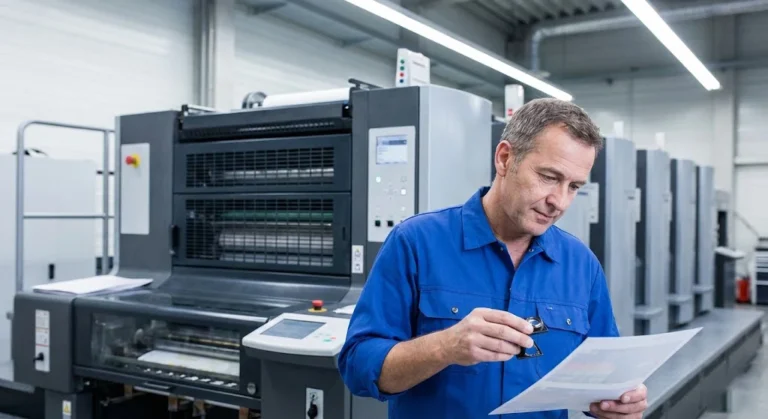
At the beginning of the 20th century, offset printing emerged as an adaptation of lithography that allowed for the first time long print runs with high fidelity and competitive cost. Traditional lithography was based on the principle of repulsion between water and grease: the image was drawn on limestone or a chemically treated metal plate, and the ink adhered only to the greasy areas, while water repelled the blank areas. However, in lithography the ink transfer to paper was direct, which limited quality in long runs and wore down the plate quickly.
Offset printing introduced a fundamental change by inserting an intermediate rubber blanket cylinder between the plate and the paper. In this way, the ink was not deposited directly from the plate onto the substrate, but first transferred to the rubber and then to the paper.
The first offset inks were based on mineral oils and natural resins; they were viscous and tacky to transfer from the rubber to the paper without smudging. This system improved definition, extended plate life, and allowed printing with greater uniformity. In addition, the rubber adapted to irregular substrates, opening the door to high-quality printing on different types of paper and cardboard.
It soon became clear that the success of offset printing depended as much on machine mechanics as on the chemistry of the ink. Controlling the ink-water balance, adhesion to the substrate, and drying time was essential to achieve consistent color across millions of copies. Thus began the search for formulations that combined stability, resistance, and a wider color gamut, laying the foundation for modern inks.
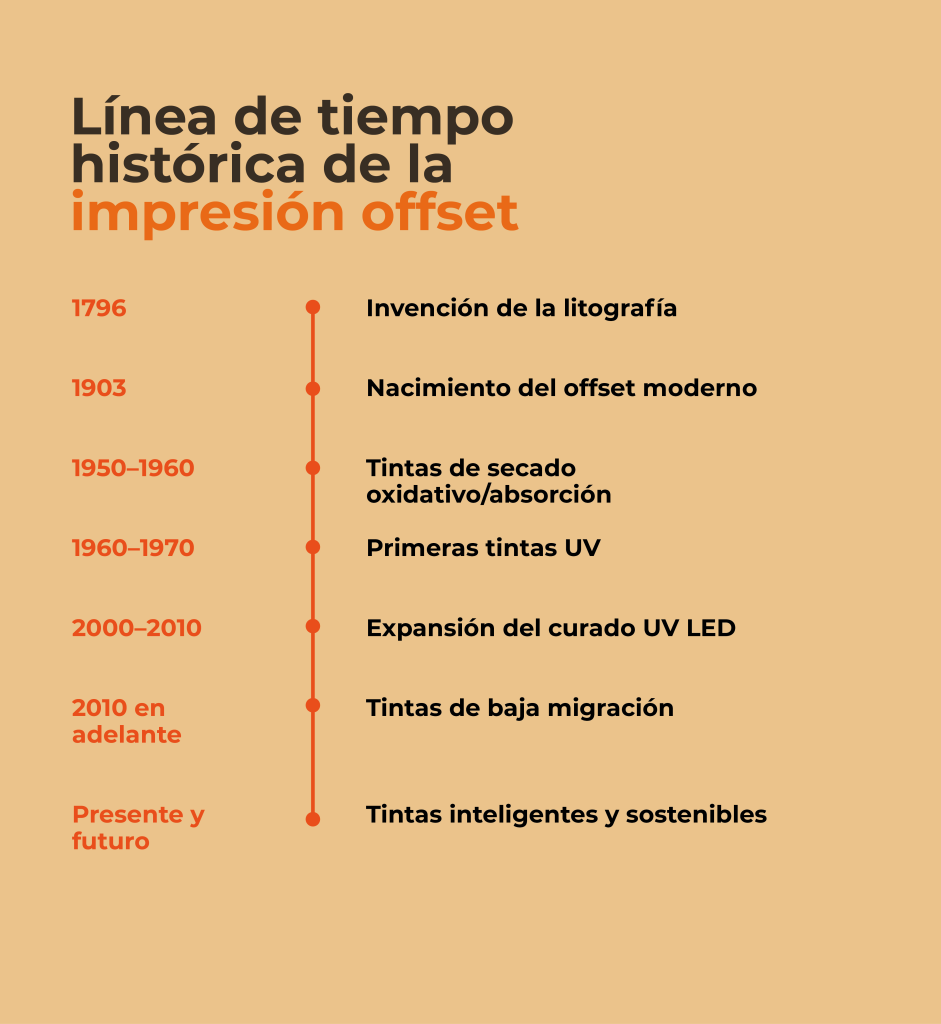
Historical timeline of offset printing
-
1796 – Invention of lithography
Alois Senefelder developed in Bavaria a method based on the repulsion between water and grease on limestone. This technique enabled highly faithful image reproduction and became the starting point of modern printing. -
1903 – Birth of modern offset printing
In the United States, Ira Washington Rubel accidentally discovered the offset system by using an intermediate rubber cylinder that improved ink transfer to paper. This discovery revolutionized print quality and durability. -
1950–1960 – Oxidative/absorption drying inks
During these decades, inks that dried through oxidation and absorption became standardized, ensuring stability in long print runs. Offset printing became the dominant technique in publishing and newspapers. -
1960–1970 – First UV inks
The introduction of ultraviolet radiation curing inks marked a radical change: instant drying, more intense colors, and the possibility of printing on new non-porous substrates. -
2000–2010 – Expansion of UV LED curing
With the arrival of LED technology, UV curing improved in energy efficiency, reduced heat emission, and increased lamp durability, making the technology more accessible and sustainable. -
2010 onwards – Low migration inks
Driven by European regulations, low migration inks became the standard for food and pharmaceutical packaging. They guarantee safety without compromising print quality. -
Present and future – Intelligent and sustainable inks
Current research points toward functional inks: conductive for printed electronics, thermochromic, advanced fluorescent, biodegradable, and digitally traceable. A new era where ink becomes more than color—it becomes technology.

Technological evolution of offset inks: quality, control, and specialization
During the 20th century, offset printing became the global standard for books, newspapers, magazines, catalogs, and packaging. This was made possible by the continuous evolution of inks, which progressed from simple compositions to increasingly sophisticated systems. International standardization introduced stricter quality control methods, and advances in pigments and resins enabled brighter colors and greater light resistance.
At the same time, inks began to diversify. For the editorial and commercial sector, versatile and machine-stable formulations were developed to ensure long print runs without color fluctuations. Packaging, on the other hand, required inks with stronger adhesion, superior gloss, and compatibility with protective varnishes. Specialty inks also emerged, such as metallic and fluorescent inks, offering brands new creative possibilities. Finally, innovation in drying systems introduced fast-curing inks such as UV and later UV LED, enabling spectacular results on non-porous substrates.

Current challenges of offset inks:
Today, offset ink is called to respond to an environment defined by sustainability, regulatory safety, and productivity. These three pillars shape both research into new products and decision-making by printers and brands.
Sustainability, safety, and productivity

MA Inks in the evolution of offset inks
Since our founding in 1932 as Tintas Martínez Ayala S.A., we have been a reference manufacturer of inks for the graphic arts industry. We began in Totana producing inks and varnishes artisanally, and today, under the name MA Inks, we develop advanced solutions that combine innovation, sustainability, and high performance.
For more than 90 years, we have evolved alongside the graphic sector, adapting our technologies and expanding our presence to more than 70 countries. This transformation reflects our constant commitment to quality, continuous improvement, and close relationships with our customers.
Today, at MA Inks, we focus on quality, sustainability, and innovation as the pillars of our value proposition. Our catalog includes a wide range of conventional and specialty offset inks, designed to meet different sectors and needs.
Challenges and future: what lies ahead
Beyond current challenges, the future of offset inks points toward new technological horizons. One of the most promising fields is process digitalization: from traceability of each ink batch through connected systems to real-time data integration across the entire workflow. This enables automated quality control, predictive analysis of ink behavior on press, and logistics chain optimization, contributing to waste reduction, shorter setup times, and improved overall efficiency.
Another emerging area is the development of functional and intelligent inks, capable of providing added value beyond color. These include conductive inks for printed circuits, thermochromic inks that change color with temperature, and formulations with antibacterial properties for medical and food packaging.
At the same time, quality will remain a strategic axis. Choosing precisely formulated inks not only ensures consistent colors and flawless finishes but also improves productivity by reducing stoppages, waste, and reprocessing. In an increasingly competitive market, quality is no longer optional—it is a decisive advantage.
Finally, the circular economy will define a decisive path forward: from formulations using recycled or biodegradable raw materials to solutions that facilitate printed packaging recycling. These advances will require collaboration between ink manufacturers, printers, and brands to close the loop efficiently.
Conclusion
Offset inks have undergone more than a century of evolution, from early mineral formulations to today’s LED-curing and low migration solutions. Their history is also that of the graphic arts industry: a story of adaptation, creativity, and technical excellence. Today, these inks are more than a vehicle for color; they are a strategic tool for ensuring safety, sustainability, and differentiation.
At MA Inks, we believe the future is built on responsible innovation, quality, and the expertise of those who understand the craft of printing. That is why we continue researching, creating, and supporting industry professionals. Because, just as a century ago, offset ink remains synonymous with quality, trust, and innovation.
Do you want to learn more about how our inks can help you improve your printing processes? Contact us today and discover everything we can contribute to your printing project.